
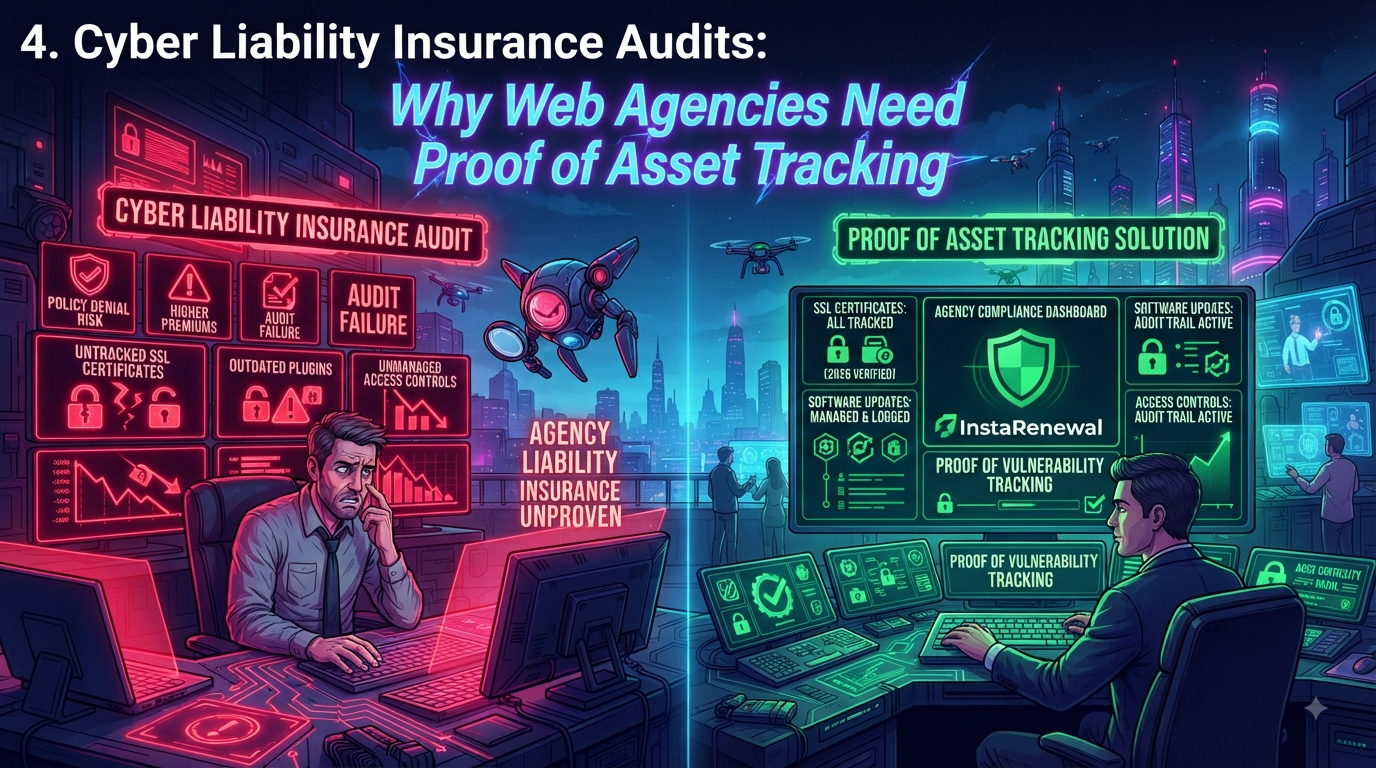
Cyber Liability Insurance Audits: Why Web Agencies Need Proof of Asset Tracking
For years, securing web development liability insurance or a cyber policy was a straightforward administrative task. Agency owners filled out a short self-assessment questionnaire, checked a few boxes confirming basic security measures, paid an annual premium, and filed the policy away.
That era is over. In 2026, IBM and the Ponemon Institute put the global average cost of a data breach at a record $4.99 million, up 12% year over year, while breaches at U.S. organizations averaged $11.5 million — more than double the global figure. Detection, escalation, and lost-business costs drove most of the increase. At the same time, Verizon's 2026 Data Breach Investigations Report found that 48% of breaches involved a third party, a 60% jump in a single year, as attackers increasingly go after the vendors, agencies, and managed service providers (MSPs) that hold administrative access to many downstream businesses at once.
Insurance carriers have responded by overhauling how they underwrite agencies and consultancies. Verbal promises and generalized self-attestation no longer satisfy underwriters. Instead, they run evidence-based reviews where applicants must produce verifiable proof of access governance, software and license currency, SSL/domain monitoring, and centralized asset records. If your agency can't produce an organized, up-to-date inventory showing what assets you manage, who owns them, where they live, and who has access, you face steep premium increases, coverage exclusions, or outright application denial.
This guide covers why cyber insurers have tightened their standards, what underwriters actually evaluate during an audit, and how disciplined asset tracking — paired with the identity and access controls it doesn't replace — helps your agency get through underwriting with fewer surprises.
1. The Underwriting Shift: From Self-Attestation to Evidence-Based Audits
Historically, cyber liability claims were driven mainly by direct breaches of a company's own network. Today, agencies and MSPs represent high-value supply-chain attack vectors. An agency holding administrative access to dozens or hundreds of client website environments, hosting accounts, and domain registrars is a single point of failure: compromise one set of centralized credentials or one neglected staging server, and an attacker can potentially reach every downstream client environment at once.
This isn't theoretical. The 2021 Kaseya VSA incident, in which a single compromised remote-management platform was used to push ransomware to roughly 1,500 downstream businesses through about 60 managed service providers, remains the reference case for the industry. More recent threat reporting shows the pattern continuing: ConnectWise's 2026 MSP Threat Report describes attackers increasingly exploiting trusted identities, remote-access tooling, and software supply chains — rather than novel exploits — to move from one compromised provider into many client environments.
Underwriters now view agencies through that lens. They're not just asking whether you own security tools; they want documented proof of how you track, govern, and can account for every asset under your care — a rough contemporary version of the older "if it isn't documented, it's assumed unmanaged" underwriting logic that has become common across the industry.
2. Cyber Liability vs. Technology Errors & Omissions (Tech E&O)
Agency operations managers often conflate Cyber Liability Insurance with Technology Errors & Omissions (Tech E&O). While the two are frequently bundled into a single policy, they respond to different risk categories.
| Cyber Liability Insurance (Attack-Driven Security Events) | Technology E&O Insurance (Professional & Code Failures) | |
|---|---|---|
| Covers | Ransomware/malware extortion, exfiltrated client data, unauthorized system access, forensic investigation and crisis response | Defective code, missed deadlines, unhandled API/dependency failures, contractual breach claims |
Cyber Liability Insurance covers first-party and third-party losses from malicious attacks, unauthorized access, extortion, and data breaches.
- First-party coverage pays for forensic investigation, legal counsel, crisis communications, business-interruption loss, and notification/credit-monitoring costs.
- Third-party coverage protects the agency if a client sues because a breach originating in the agency's infrastructure compromised the client's data or operations.
Technology E&O protects the agency against claims that its professional service, code, or technical advice failed to deliver promised results and caused a client financial harm — for example, an unvetted plugin update that breaks a client's checkout flow during a peak sales period, leading to a lost-revenue claim.
Underwriters evaluating either policy want proof of a clean operational registry: cyber underwriters want evidence that entry points (domains, SSL certificates, admin portals) are being tracked and kept current; Tech E&O underwriters want evidence that client assets, licenses, and contractual scopes are clearly recorded and governed.
3. What Underwriters Audit: The Core Proof Areas
During a cyber or Tech E&O audit, carriers typically inspect several operational areas. Missing or incomplete documentation in any of them can affect eligibility, pricing, or the exclusions attached to a policy. It's worth being explicit about which of these an asset-tracking platform like InstaRenewal can help document, and which require separate identity and security tooling — conflating the two is one of the more common (and costly) mistakes agencies make when assembling an underwriting submission.
| Audit Area | What Underwriters Look For | Common Failure Point | Who Handles the Evidence |
|---|---|---|---|
| Identity & Access Controls | Documented MFA coverage across email, cloud platforms, registrars, and client admin portals — typically 98–100% coverage on user accounts and 100% on privileged/admin accounts | Admin accounts belonging to former contractors, or MFA enforced on primary Google Workspace/M365 accounts but not on legacy cPanel, registrar, or staging logins | An identity provider (e.g., an SSO/MFA platform), not an asset tracker |
| Asset Inventory & Software Licensing | A current, centralized registry of active client websites, hosting accounts, staging environments, and premium software/plugin licenses | Shadow IT — unmanaged staging subdomains running outdated CMS core files that nobody remembers exist | An asset-tracking platform like InstaRenewal |
| SSL/TLS & Domain Monitoring | Tracking of domain ownership, renewal dates, and SSL/TLS certificate expiration timelines | A client domain or certificate lapsing, producing browser security warnings or opening a window for domain hijacking | An asset-tracking platform like InstaRenewal |
| Offboarding & Access Revocation | Documented SOPs for revoking vendor and employee credentials when engagements end | Former freelancers retaining SSH keys, cPanel access, or API keys months after their contract ends | An IAM/PAM (privileged access management) process and platform, not an asset tracker |
On identity and access controls: MFA enforcement is now close to a hard prerequisite for policy approval, and underwriters increasingly ask for evidence — not just a "yes" — of coverage percentages across every admin surface, including ones agencies often forget, like registrar accounts and legacy cPanel logins.
On asset inventory and licensing: You can't protect, or prove you're managing, what you haven't catalogued. Underwriters want an up-to-date registry; orphaned staging servers or unlicensed premium plugins running on client sites are a recurring audit failure point.
On SSL and domain monitoring: Stale certificates and lapsed domain renewals are concrete, checkable failure points precisely because they're easy for an underwriter (or an attacker) to verify from the outside.
On offboarding and credential lifecycles: When contractors or employees leave, their access needs to be systematically revoked across every platform they touched — not just the primary email system. This is fundamentally an identity and access management discipline, and it lives outside what a renewal- and asset-tracking platform is built to do.
4. The Real Cost of Falling Behind
Failing to meet current underwriting expectations doesn't only mean a rejection letter — the consequences are more varied, and the current market makes them easy to underestimate.
The pricing picture is more nuanced than a flat "premiums are spiking." After a hard market in 2020–2022, cyber insurance pricing softened substantially: Howden has reported roughly a 22% cumulative rate decline from the 2022 peak, and U.S. direct written premiums fell for the first time on record in 2024, down about 7%, according to NAIC data. Heading into 2026, though, analysts including S&P Global Ratings have flagged that the softening cycle is decelerating, with forecasts of renewed rate increases in the 15–20% range as claim frequency climbs back up. The practical takeaway for agencies: overall market pricing is closer to flat-to-favorable for well-documented applicants than it was a few years ago, but that favorable pricing is now conditional. Businesses that can't produce evidence of the controls above are seeing premium increases well above the market average — industry underwriting guides commonly cite 40–100% increases for gapped applicants, and firms pushed into surplus-lines markets after standard-market decline can pay two to three times the standard rate for comparable coverage.
Specific exclusions can gut a policy even when it's issued. "CVE exclusions" tied to unpatched, publicly known vulnerabilities are becoming more common, though carriers vary in how they structure them. Cyber insurer Coalition has reported that at least one well-known U.S. carrier excludes losses tied to vulnerabilities with a CVSS severity score above 8.0 if a patch was available for three weeks and not applied; other carriers use sliding-scale co-insurance tied to grace periods that commonly run 30–45 days from patch release. Whatever the exact terms, the effect is the same: if a client site is breached through a plugin or CMS vulnerability that had a patch available and unapplied past the carrier's grace period, and you can't show a documented patch-tracking process, the claim is a strong candidate for denial. Overall, more than 40% of cyber insurance claims in 2026 close with no payout, and exclusions of this kind are among the most common reasons cited.
Misrepresentation can void coverage retroactively — and courts have upheld it. In Travelers Property Casualty Co. of America v. International Control Services, Inc. (C.D. Ill., filed 2022), the insured had stated on its application that MFA was deployed across administrative and privileged access; in practice, MFA only protected the firewall. After a ransomware attack exploited an unprotected administrative account, Travelers sought to rescind the policy for material misrepresentation, and the court agreed — the policy was voided, and courts in similar cases have found that carriers don't need to prove the misrepresentation directly caused the loss for rescission to apply. This is exactly why an accurate, current asset and access record matters at application time, not just after an incident.
5. Building an Audit-Ready Tracking System: A Practical SOP
To move through underwriting with fewer surprises, agencies need a standardized system in place of ad hoc spreadsheets. This SOP breaks the work into what belongs in an asset registry and what belongs in an access-governance process.
Step 1 — Centralize your technical infrastructure footprint. Catalog every asset tied to your agency and client portfolio: production domains, staging subdomains, development servers, DNS managers, registrars, hosting accounts, SSL/TLS certificates, and premium software or plugin licenses.
Step 2 — Establish "who owns" vs. "who pays." Record asset ownership clearly:
- Client direct: the client holds the billing account; the agency holds delegated management access.
- Agency reseller/care plan: the agency owns the master hosting account or license and bills the client as part of a recurring service.
This distinction matters during both insurance claims and contractual disputes, since it helps determine liability and scope.
Step 3 — Run access-control governance as a separate, recurring process. Maintain a monthly (or more frequent) review of user credentials tied to client environments, and confirm that former team members, contractors, and inactive accounts have been removed across every platform — not just the ones that are top of mind. This step sits with your identity/IAM tooling and offboarding checklist, not your asset tracker.
Step 4 — Automate expiration and renewal alerts. Configure alerts for domain, SSL, hosting, and software license renewals well before they lapse, so nothing expires silently on a client-facing property.
Step 5 — Generate periodic records. Keep exportable, dated logs of your asset inventory and renewal history. Underwriters treat consistent, time-stamped records as meaningfully stronger evidence than a one-time snapshot assembled right before a renewal deadline.
6. Where InstaRenewal Fits — and Where It Doesn't
For growing agencies, manually tracking renewal and expiration dates across dozens of registrars, hosts, and software vendors is unsustainable on spreadsheets. InstaRenewal is built to solve that specific piece of the problem: it's a centralized renewal-tracking, expiration-alerting, and asset record-keeping platform for domains, SSL certificates, hosting accounts, and software/plugin licenses.
What that means for underwriting evidence:
- Centralized asset registry: Consolidate client domains, hosting accounts, SSL certificates, and software licenses into one dashboard instead of scattered spreadsheets — directly supporting the "Asset Inventory & Software Licensing" audit area above.
- "Who owns" vs. "who pays" records: Track legal asset ownership separately from billing responsibility, which is useful evidence for both Tech E&O contract disputes and cyber underwriting questions about environment ownership.
- Renewal and expiration alerts: Get notified ahead of domain, SSL, hosting, and license expirations so nothing lapses unnoticed on a client-facing property — supporting the "SSL/TLS & Domain Monitoring" audit area.
- Exportable asset records: Pull a dated inventory report to attach to an underwriting submission or client audit request as evidence of ongoing asset governance.
What InstaRenewal is not: it doesn't enforce or verify MFA, store or vault credentials, manage IAM roles, log admin access to client environments, or monitor for active security threats. Those are the domains of an identity provider/SSO platform, a password manager or PAM tool, and an EDR/security monitoring stack, respectively — and they cover the "Identity & Access Controls" and "Offboarding & Access Revocation" areas that underwriters audit separately. An agency that walks into underwriting with a clean InstaRenewal export but no MFA enforcement or offboarding SOP is still going to hit the same wall those controls are designed to catch — the Travelers case above is a reminder that overstating access controls on an application, even unintentionally, carries real consequences. Asset tracking and access governance are complementary, not interchangeable, and a complete audit submission needs evidence from both.
7. Practical Checklist Before You Apply or Renew
Asset and renewal tracking (supported by a platform like InstaRenewal):
- [ ] Every client site, staging server, domain, and active SSL certificate is logged in a centralized tracking system.
- [ ] All premium plugins, themes, and framework licenses are current and assigned to specific client records.
- [ ] Asset ownership ("who owns" vs. "who pays") is documented for every client environment.
- [ ] A dated asset inventory export is ready to attach to the underwriting application.
Identity, access, and patching (handled by separate IAM/security tooling and SOPs):
- [ ] MFA is enforced — and documented — across email, hosting dashboards, cloud providers, and registrar accounts, including legacy and staging logins.
- [ ] Inactive accounts, former contractor credentials, and stale SSH/cPanel logins have been reviewed and purged across all environments in the last 30–90 days.
- [ ] A patch-tracking process exists with defined timelines for critical updates, so you can show when a known vulnerability was patched relative to its disclosure date.
- [ ] Client Master Services Agreements include clear liability caps, defined scopes of service, and explicit language on asset ownership boundaries.
Replacing informal, spreadsheet-based tracking with a structured system for both asset governance and access control gives agencies a materially stronger position at underwriting — not because either piece alone satisfies carriers, but because together they answer the two questions every 2026 cyber or Tech E&O audit is really asking: what do you manage, and who can get into it.
---
This article is for general informational purposes and does not constitute legal, financial, or insurance advice. Cyber liability and Tech E&O underwriting requirements vary by carrier and jurisdiction; agencies should consult a licensed insurance broker or attorney before making coverage decisions.