
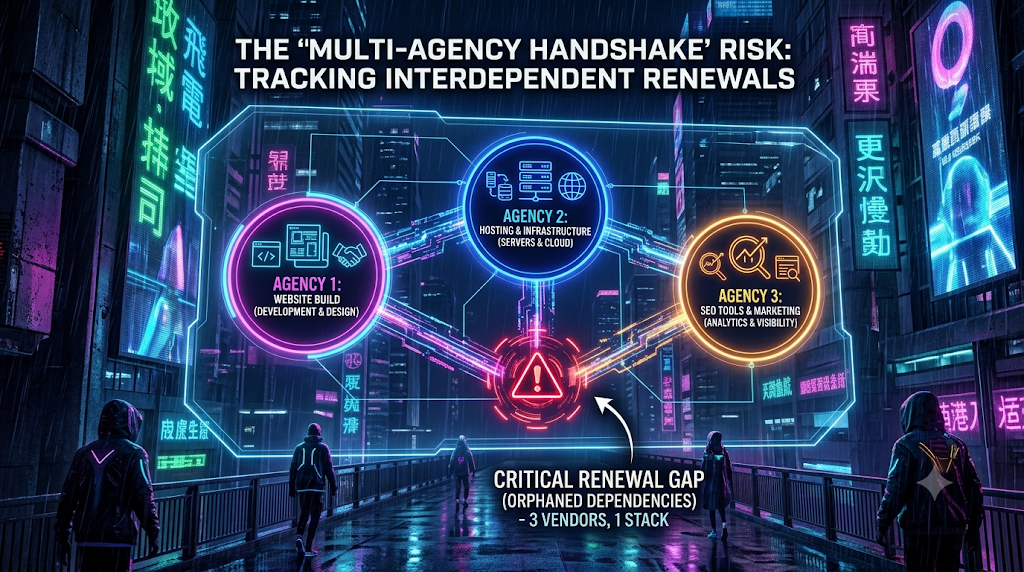
Modern web teams often split the stack across specialists instead of consolidating it with one provider. A common arrangement looks like this: Agency A designs and builds the front end and backend code, Agency B provides managed cloud hosting and DevOps, and Agency C handles search engine optimization (SEO), analytics, and third-party monitoring tools.
This division of labor can produce excellent work, but it creates a specific operational risk: the Multi-Agency Handshake Risk.
When renewals, licenses, and technical configurations are spread across three independent vendors, ownership becomes ambiguous. A missed renewal in that environment rarely looks like a simple unpaid invoice. It looks like a site that stops resolving, a CDN that can’t reach its origin, a search box that returns nothing, or a crawler that gets blocked.
The real-world precedent is sobering. On December 6, 2018, an expired certificate embedded in Ericsson software used by mobile operators took down data services for roughly 32 million O2 customers in the UK. The outage also hit Softbank in Japan, and it spread downstream to virtual operators such as Giffgaff, Sky Mobile, and Tesco Mobile. The expired item belonged to a supplier, the outage landed on the operators, and the customers paid for it. That is the handshake problem at scale.
This guide explains why the multi-agency handshake fails, maps how one lapsed renewal cascades across vendors, and sets out a framework for unified tracking and governance. It also corrects a few common technical assumptions that show up in vendor-risk discussions.
---
1. Deconstructing the “Multi-Agency Handshake” Risk
The handshake risk appears when operational continuity depends on silent compliance and implicit handoffs between providers. Each agency works under its own contract and Service Level Agreement (SLA), but none is contractually responsible for the health of the whole stack.
              +-------------------------------+
              |      THE CLIENT'S STACK       |
              +---------------+---------------+
                              |
        +---------------------+---------------------+
        |                     |                     |
        v                     v                     v
 +--------------+      +--------------+      +--------------+
 |   AGENCY A   |      |   AGENCY B   |      |   AGENCY C   |
 | Development  |      | Hosting &    |      | SEO, analytics|
 | & custom code|      | cloud / DevOps|     | & integrations|
 +--------------+      +--------------+      +--------------+
        |                     |                     |
        +---------------------+---------------------+
                              |
                              v
              +-------------------------------+
              |   THE ORPHANED RENEWAL ZONE   |
              | (SSL, DNS, API plans, tools)  |
              +-------------------------------+
The Triangle of Ambiguity
Consider a typical high-growth web operation:
- Agency A (Development) builds custom modules on third-party services such as site search, form processing, and image rendering.
- Agency B (Managed Infrastructure) provisions cloud servers (for example on AWS or Azure), manages web application firewall (WAF) rules, and installs or automates TLS certificates on the origin server.
- Agency C (SEO & Growth) configures edge or CDN settings, log-file analysis, rank tracking, and structured-data tooling.
When a client assumes “the agencies are talking to each other,” a governance gap opens. Agency A assumes Agency B watches infrastructure renewals. Agency B assumes the client’s IT team holds the domain registrar login. Agency C installs scripts and integrations tied to accounts it owns itself.
Domain renewals show why this matters. Under ICANN’s Expired Registration Recovery Policy, registrars of generic top-level domains (gTLDs such as .com) must send expiration notices to the registered name holder. They send two before expiry, at roughly one month and one week, and at least one more within five days after expiry if the domain hasn’t been renewed. Those notices go to the contact on file. If that contact is a former employee, an agency mailbox that nobody reads, or a personal address, the people who can fix the problem may never see the warning.
---
2. Anatomy of an Interdependent Outage: Technical Dependency Mapping
To see why multi-agency renewals fail, map how a single lapse propagates. A lapsed item owned by one vendor can break a component operated by another.
+--------------------------------------------------------------------------+
|                         THE DEPENDENCY CASCADE                           |
+--------------------------------------------------------------------------+
| Layer 1: Domain & DNS         -> Lapse typically takes the site offline  |
| Layer 2: Infrastructure & TLS -> Lapse triggers errors or browser blocks |
| Layer 3: Application & APIs   -> Lapse breaks functionality that relies  |
|                                  on a third-party service                |
| Layer 4: SEO & Monitoring     -> Lapse blinds reporting; blocked         |
|                                  crawlers can affect indexation          |
+--------------------------------------------------------------------------+
Scenario A: The Orphaned Origin Certificate
- The interdependency: Agency A built the application. Agency B manages the origin server and its TLS certificate. Agency C set up a CDN and reverse proxy (for example Cloudflare) for caching and international performance.
- The vulnerability: The certificate on the origin expires, and nobody at Agency B or the client is alerted in time.
- The outcome depends on the proxy’s encryption mode. In Cloudflare’s Full (strict) mode, the proxy validates the origin certificate and rejects an expired one. Visitors then see Error 526 (Invalid SSL certificate). Error 525 (SSL handshake failed) is the neighboring error and points to a handshake that never completes, for example because nothing is listening for TLS on port 443 or the protocols and ciphers don’t match. In the non-strict Full mode, Cloudflare doesn’t validate the certificate, so the site may keep working, but it does so with weaker protection against impersonation.
- The finger-pointing: Agency A says the code is fine. Agency B says the server is up. Agency C points to origin connection errors.
- The search impact: Google’s crawling documentation says server errors (5xx) and 429 responses cause Googlebot to slow its crawl, and that URLs persistently returning server errors are eventually removed from the index. A short outage usually doesn’t remove pages. A prolonged one can.
A design note on mitigation: Cloudflare offers Origin CA certificates with long lifetimes (up to 15 years), but they are trusted only by Cloudflare’s proxy. If the proxy is ever bypassed or replaced, browsers won’t trust them. Long-lived origin certificates reduce expiry risk but create a migration dependency that also needs an owner.
Scenario B: The Abandoned API Subscription
- The interdependency: During development, Agency A integrated a hosted site-search service (such as Algolia) under its own billing account. The site’s internal search, filters, and listing pages depend on it.
- The vulnerability: The client’s contract with Agency A moves to a lighter retainer, or the card on the agency’s account expires and an invoice goes unpaid.
- The outcome: Algolia’s support documentation describes the sequence for paid applications. Algolia retries payment and sends notifications, then blocks the application after a 16-day window if the invoice isn’t paid. While blocked, API calls including routine search requests return 403 (Forbidden), the front-end search stops returning results, and the application may eventually be deleted. Note that these notices go to the account owner, which here is Agency A, not the client.
- The search impact: Search and filter widgets stop working for users right away. Whether crawlers are affected depends on the build. If listing or category pages fetch their content from the API at render time, crawlers can see empty pages. If content is server-rendered from your own database, the effect is mostly on user experience.
Scenario C: Allowlist Drift Between the WAF and a Third-Party Tool
- The interdependency: Agency C runs an enterprise crawler and log-analysis tool. To let it through Agency B’s WAF, Agency B allowlists the tool’s IP ranges or tokens.
- The vulnerability: Tools change infrastructure over time. If the vendor’s IP ranges change, or the allowlist entry is tied to a subscription that was replaced, the static rule goes stale. Nobody tells Agency B.
- The outcome: The WAF treats the tool’s traffic as suspicious and blocks or rate-limits it, returning 403 or 429 responses. At minimum, Agency C loses visibility into crawl behavior without realizing why.
- How far the damage goes: Be precise here. A blocked third-party crawler does not by itself affect Google’s index. The indexation risk arises only if the same WAF rules start blocking or throttling Googlebot. Google’s documentation says URLs returning 4xx errors (other than 429) are treated as nonexistent and removed from the index, while 429 and 5xx responses slow the crawl. Google publishes its crawler IP ranges, and it recommends verifying Googlebot with reverse DNS lookups instead of trusting the user-agent string alone. Verified-bot rules in the WAF hold up better than hand-maintained IP lists.
---
3. The Root Causes of Multi-Agency Renewal Failures
Why do capable organizations keep hitting these problems? Four structural issues drive the risk.
1. Account Ownership Under Agency Master Accounts
Agencies commonly register SaaS tools, domains, or cloud resources under their own master accounts for convenience or bulk pricing. When they do:
- The client has little visibility into renewal windows, usage thresholds, and contract end dates.
- Notices, invoices, and failure alerts go to the agency, not the client.
- If the client offboards the agency, transferring ownership can mean a negotiation and a technical migration while the clock is running.
2. SLA Blind Spots
Standard SLAs usually cover specific components: uptime for hosting, bug fixes for custom code, deliverables for SEO. They often exclude the seams between vendors:
- A hosting SLA may guarantee 99.99% server uptime while excluding third-party DNS management and application-layer script failures.
- A development agreement may cover fixes for the code Agency A wrote but exclude deprecations or license changes at third-party SaaS providers.
Check the exclusions section of each contract. The gaps are usually written down.
3. Misaligned Renewal Cycles and Notice Windows
The assets in one stack run on unrelated calendars:
- Agency retainers often run on annual or quarterly terms.
- Cloud infrastructure may be billed monthly on usage, or covered by one- or three-year commitments such as AWS Reserved Instances or Savings Plans.
- SaaS and SEO tools commonly auto-renew annually, and many contracts require written notice of non-renewal well ahead of the renewal date (60 to 90 days is common, but check each contract).
- TLS certificates are getting shorter-lived, which adds more renewal events to track (see below).
Without a central view, auto-renewals lock organizations into tools they no longer use, while other items expire quietly because a payment card changed.
4. Certificate Lifetimes Are Shrinking
Public TLS certificates have much shorter maximum lifetimes than they did a few years ago. Under CA/Browser Forum Ballot SC-081v3, the maximum validity dropped to 200 days on March 15, 2026, from 398 days. It falls to 100 days on March 15, 2027 and 47 days on March 15, 2029. Let’s Encrypt, which already issues 90-day certificates, has announced its own schedule to reach 45 days by 2028.
Two operational consequences follow:
- Manual certificate renewal becomes impractical at these frequencies, so automation (for example ACME clients) becomes the norm. Automation itself can fail silently after a server change, which is why independent monitoring still matters.
- Let’s Encrypt ended its expiration notification emails on June 4, 2025 and suggests third-party monitoring for anyone who wants alerts. If Agency B relies on those emails to catch a broken renewal, that safety net no longer exists.
---
4. The Unified Vendor Tracking Framework
To close the handshake gap, move from decentralized agency management to a single source of truth that the client controls.
Step 1: Run a Technical and Commercial Stack Audit
Catalog every asset, dependency, and tool, with both its technical details and its commercial terms. Record who operates it, who pays for it, and who receives the notices.
Multi-Vendor Asset Inventory Matrix (Illustrative)
The vendors, owners, and dates below are placeholders to show the structure. Replace them with your real records.
| Asset Layer | Operational Owner | Example Vendor | Commercial Owner (Who Pays?) | Renewal Cadence / Date | Alert Lead Time | Critical Dependency |
|---|---|---|---|---|---|---|
| Domain & DNS | Client IT (registrant) / Agency B (technical) | Registrar / Route 53 / Cloudflare | Client | Annual (e.g., Oct 15) | 60 days | Core resolution |
| Public TLS certificate | Agency B | Let’s Encrypt / commercial CA | Agency B (rebilled) or client | Auto-renewed; max 200 days now, 100 days from Mar 2027 | 30 days, then 15 and 7 | Front-end HTTPS |
| Application repository | Agency A | GitHub | Client | Annual | 30 days | Build and deploy pipeline |
| Site search API | Agency A | Algolia | Agency A account (risk) | Monthly or annual | 30 days | Search, filters, listings |
| Hosting (origin) | Agency B | AWS / Azure | Client | Monthly, or 1 to 3 year commitment | 90 days | Backend and database |
| Edge / CDN / WAF | Agency B and Agency C | Cloudflare | Client | Annual | 60 days | CDN and security rules |
| SEO platform | Agency C | Botify / BrightEdge | Agency C account (risk) | Annual | 90 days | Log analysis, crawl data |
The two rows flagged “risk” are the pattern to look for: a critical dependency paid for and noticed through a vendor’s account, not the client’s.
---
Step 2: Set Account Architecture Standards
Apply consistent rules to purchasing and access:
- Client ownership of core assets. Domains, TLS certificates, cloud accounts, and critical SaaS subscriptions should be registered to the client, ideally to a shared role-based address (for example
tech-procurement@company.com), not to an individual’s mailbox or an agency account. - Delegated access, not root ownership. Agencies should work through delegated roles (cloud IAM roles, single sign-on, or role-based access control) and should not hold the root or billing-owner login for client accounts.
- Client-side billing contacts. Make sure renewal notices, price-change warnings, and non-renewal deadlines reach a finance or procurement contact at the client, not only the agency.
---
Step 3: Build a Cross-Agency Responsibility Matrix (RACI)
Create an explicit RACI matrix for shared operations and have each agency sign off on its role. The convention is one Accountable party per task.
| Action Item | Internal IT | Agency A (Dev) | Agency B (Host) | Agency C (SEO) |
|---|---|---|---|---|
| DNS record changes | Accountable | Consulted | Responsible | Informed |
| TLS certificate renewal | Accountable | Informed | Responsible | Informed |
| CMS / framework upgrades | Accountable | Responsible | Consulted | Informed |
| CDN / edge rule changes | Accountable | Consulted | Responsible | Consulted |
| Third-party API key and plan audits | Accountable | Responsible | Informed | Consulted |
| Schema / structured data scripting | Accountable | Responsible | Informed | Responsible |
| Log access and IP allowlisting | Accountable | Informed | Responsible | Consulted |
- Responsible (R): Executes the task.
- Accountable (A): Owns the outcome and holds decision and budget authority. Only one per task.
- Consulted (C): Provides input, requirements, or specifications.
- Informed (I): Is told about changes, deployments, or maintenance windows.
---
5. Operationalizing Governance: Tracking and Monitoring
Spreadsheets and individual memory don’t survive staff turnover or vendor changes. Governance needs two layers: contract and renewal tracking (who owns what, when it renews, when notice is due) and technical monitoring (whether the asset is actually healthy).
1. Contract and Renewal Alert Workflows
Track every renewal and notice window in a central system. That can be a spreadsheet at small scale, an ITSM tool, or a dedicated SaaS-management platform such as Vertice or Spendflo for larger estates. A workable cadence:
- 90 days out: Open a review task with the internal account owner. Check utilization, performance, and vendor fit before notice windows close.
- 60 days out: Hold a cross-agency alignment call. Review technical roadmaps, price increases, and API version deprecations scheduled for the next term.
- 30 days out: Require sign-off from finance and technology leads on renewal or migration.
2. Independent Technical Monitoring
Contract tracking tells you a renewal is due. It doesn’t tell you whether a certificate is about to expire or a vendor account is blocked. Add independent checks:
- TLS certificate monitoring: Use uptime or observability tooling (for example Datadog SSL tests or New Relic’s certificate check monitors, which let you set how many days before expiry a check should fail) to alert the client’s team, not only Agency B. As lifetimes shrink toward 100 days, lead times such as 30, 15, and 7 days remain sensible.
- Domain expiry monitoring: Monitor expiry dates from the registry side, independently of any agency statement. Registration data lookups are moving from WHOIS to RDAP, so choose tooling that supports RDAP.
- Third-party endpoint health checks: Run scheduled checks against critical APIs. Treat authentication or authorization errors (401, 403) and any billing-related responses as alerts to both internal engineering and the owning agency. The exact response a vendor returns for an unpaid account varies. Algolia, for example, returns 403, so check each vendor’s documentation and don’t assume a specific code.
- Crawler and bot access checks: Periodically confirm that verified search engine bots are not being blocked or throttled by WAF rules, using Search Console’s crawl and indexing reports.
3. The Quarterly “Vendor Handshake” Review
Hold a recurring review, 45 to 60 minutes, with technical leads from Agencies A, B, and C and the client’s internal owner.
Suggested agenda:
- API and integration review: Identify third-party dependencies scheduled for deprecation or plan-tier changes over the next two quarters.
- Access hygiene: Remove stale accounts, API keys, and SSH permissions belonging to former agency staff.
- Upcoming renewals: Review everything due in the next 180 days, including licenses, hosting commitments, and retainers.
- Failure rehearsal: Walk through who does what if the domain, a certificate, or a critical API account lapses. Check that DNS and credential recovery paths work across all three vendors.
---
6. Contractual Safeguards: Building Protection into Agreements
Technical tracking should be backed by contract language. The clauses below are illustrative starting points, not legal advice. Have counsel adapt them to your jurisdiction and agreements.
Clause 1: Account Governance and Asset Ownership
“All software licenses, domain names, SSL certificates, API integrations, and third-party SaaS accounts provisioned for the execution of services under this Statement of Work shall be registered under the primary ownership of [Client Company]. The Vendor shall not register any core infrastructure or tools under the Vendor’s corporate umbrella without explicit written consent.”
Clause 2: Multi-Vendor Cooperation
“The Vendor acknowledges that [Client Company] utilizes third-party agencies for complementary services including, but not limited to, development, infrastructure hosting, and digital marketing. The Vendor agrees to participate in quarterly cross-vendor alignment sessions and provide technical specifications, API adjustments, and maintenance schedules to designated third parties within five (5) business days of request.”
Clause 3: Offboarding and Asset Handoff
“Upon termination of this Agreement, the Vendor agrees to execute a 30-day transition plan ensuring uninterrupted service continuity. This includes transferring administrative access for all managed SaaS tools, exporting configuration logs, and providing written verification that all dependent API keys and billing profiles have been transitioned to [Client Company] or its designated representative.”
---
Conclusion: Turning Vendor Risk into Operational Strength
The multi-agency handshake risk is an organizational problem that surfaces as a technical one: fragmented ownership, notices going to the wrong inbox, and no single view of what renews when. Treat the three agencies as parts of one system and the gaps become visible and fixable.
To regain control:
- Own the master accounts. Domains, certificates, cloud accounts, and critical SaaS plans should belong to the client, with agencies working through delegated access.
- Centralize dates and dependencies. Keep contract dates, notice windows, and the “who pays, who gets the notice” mapping in one place the client controls.
- Assign one accountable owner per task. Use a RACI matrix that every agency has signed off on.
- Monitor independently. Check certificates, domains, and critical endpoints from the client’s side, and prepare for certificate lifetimes dropping to 100 days in March 2027.
When roles are explicit and visibility is shared, a specialized multi-vendor stack can keep its speed and expertise without carrying the hidden risk of a renewal that nobody noticed.