
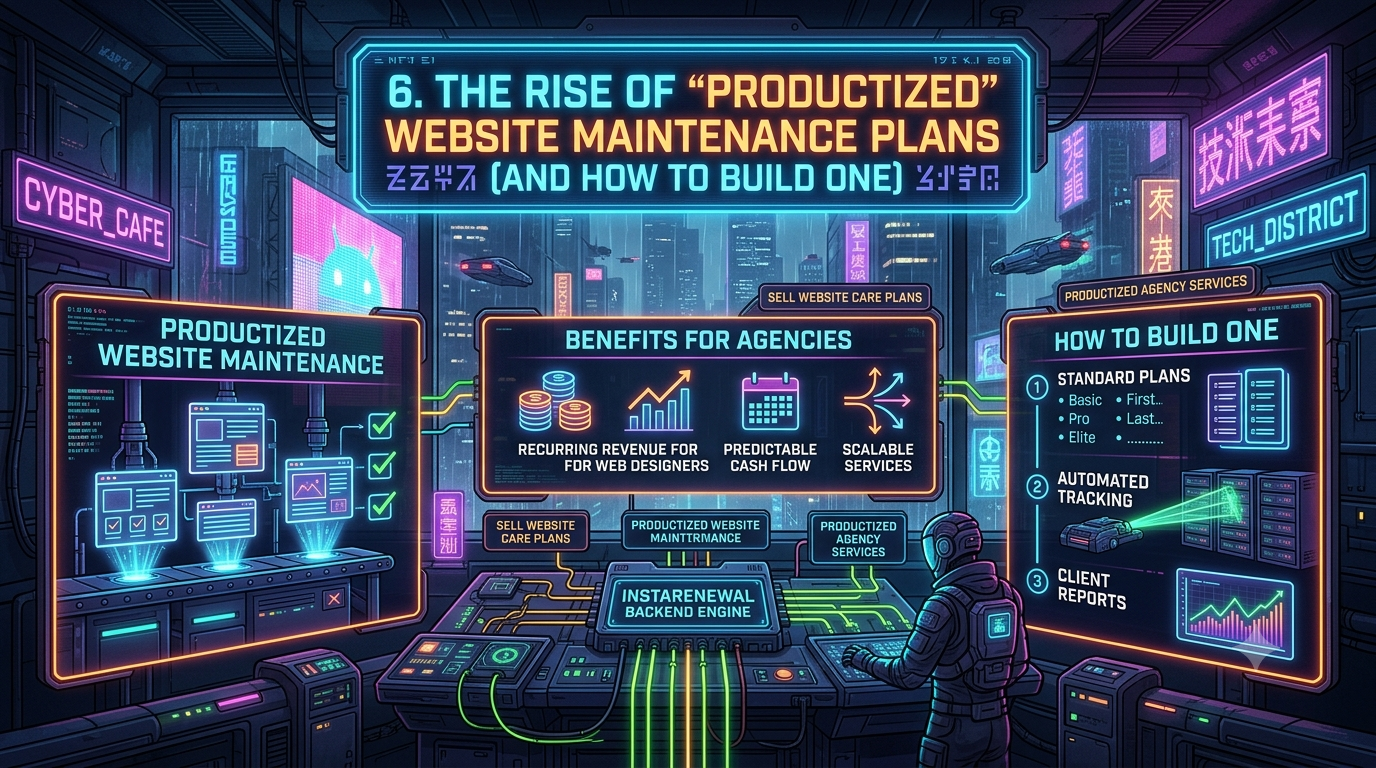
The Rise of "Productized" Website Maintenance Plans (And How to Build One)
For decades, digital agencies and freelance web designers operated under a volatile, feast-or-famine billing model: the project-based transaction. The cycle is familiar and exhausting. You land a client, build a website, launch it, collect the final invoice, and immediately return to zero monthly revenue, hunting for the next gig.
That reality is why the "productized" website maintenance plan — often called a website care plan — has become one of the most talked-about business-model shifts in the web design world. By turning a complex, manual service into a standardized, flat-rate recurring product, agencies can build predictable monthly recurring revenue (MRR) and give clients real peace of mind instead of a vague promise of "support hours."
The urgency behind this shift isn't just a sales narrative — it's backed by hard security and market data:
- WordPress now powers roughly 43.5% of all websites on the internet, making it the single largest target for automated attacks.
- Security research firm Patchstack recorded 11,334 new WordPress vulnerabilities in 2025 — a 42% jump over 2024 and the highest number ever logged in a single year.
- The median time from public disclosure to mass exploitation is now just 5 hours, and roughly 46% of vulnerabilities have no patch available at the moment they're disclosed.
- An estimated 13,000+ WordPress sites are compromised every day.
Outdated, unmonitored websites don't just look neglected — they become the easiest targets on the internet. This guide covers the strategy, tiers, pricing, and SOPs behind building a profitable maintenance-plan business, along with the operational tooling needed to run it without things slipping through the cracks.
---
1. The Strategic Shift: Custom Retainers vs. Productized Services
Traditionally, agencies that wanted recurring income proposed a "custom support retainer" — something like 5 hours of general development help per month for a flat fee. These arrangements tend to break down for two predictable reasons: scope creep and value invisibility.
Clients rarely understand what's actually included in a vague retainer, which leads to disputes over whether a new feature request is "covered." And if nothing breaks in a given month, clients start to feel they're paying for nothing and cancel.
Productized services solve this by shifting the conversation from purchased labor hours to purchased outcomes and deliverables.
The Productized Definition: A productized service is a standardized, fixed-scope offer packaged with a clear name, a defined list of inclusions, set delivery timelines, and a public, upfront price. It's marketed and purchased more like a SaaS subscription than a custom consulting engagement.
This shift is well underway industry-wide. A 2025 RSW/US agency survey found that 62% of marketing service firms are already packaging some of their offerings into productized services, and 86% planned to expand that approach over the following year.
---
2. Anatomy of a High-Value Productized Website Maintenance Plan
To sell care plans effectively, design offers for different business sizes using the classic "Goldilocks" structure: three tiers (Starter, Professional, Premium), where the target client naturally lands on the middle tier while higher-intensity clients self-select into the top one.
Tier 1: The Essential Core Plan (Basic Security & Backups)
Designed for local small businesses, brochure sites, and simple marketing pages. Mostly automated, with minimal manual work from your team.
- Hosting: High-performance managed hosting (white-labeled via a reseller account).
- Backups: Weekly full-site backups stored off-site (e.g., cloud object storage).
- Security Updates: Automated core, theme, and plugin updates, ideally tested on staging before going live.
- Uptime Monitoring: 24/7 automated uptime checks with downtime alerts.
- Support: Email-only support, roughly 48-hour response.
- Typical Pricing: $20–$95/month for automated-only plans; most "real" starter-tier plans with light human oversight land around $49–$99/month.
Tier 2: The Professional Growth Plan (Performance & Small Edits)
Designed for mid-sized marketing sites, active content sites, and corporate setups. This is usually the core engine of a maintenance business.
- Everything in Tier 1, plus:
- Daily Backups for sites with frequent content changes.
- Active Security: Web Application Firewall (WAF) monitoring and malware scanning. Note: even solid hosting-level security only intercepts a portion of exploit attempts (independent research puts standard hosting defenses at blocking roughly a quarter of attacks), so a dedicated WAF and monitoring layer matters more than it used to.
- Core Web Vitals Optimization: Monthly performance review targeting Google's current "good" thresholds — Largest Contentful Paint (LCP) under 2.5 seconds, Cumulative Layout Shift (CLS) under 0.1, and Interaction to Next Paint (INP) under 200 milliseconds. INP (which replaced First Input Delay in 2024) is now the metric most sites fail, since it depends on JavaScript execution rather than just image or server optimization.
- Design & Copy Retainer: 30–60 minutes of small content updates or layout tweaks per month (non-cumulative).
- Monthly Success Report: An automated, co-branded report showing what was protected, updated, and optimized.
- SLA: Priority ticket response within 12–24 hours.
- Typical Pricing: $95–$299/month, with most full-service small-business plans clustering around $150–$200/month.
Tier 3: The Enterprise/eCommerce Plan (High Performance & Priority Dev)
Designed for online stores (WooCommerce/Shopify), high-traffic sites, and multi-user web apps where downtime causes immediate revenue loss.
- Everything in Tier 2, plus:
- Continuous Backup Cycles: More frequent database backups, ideally tied to transaction volume for stores.
- Transaction Protection: Regular test checkouts to confirm Stripe, PayPal, or local payment gateways are functioning.
- Dedicated Support Hours: 2–3 hours of front-end development or SEO work per month.
- Priority-Response SLA: 1-hour response window during business hours for critical issues.
- Typical Pricing: $500–$2,500+/month, scaling well beyond that for high-traffic or multi-site enterprise accounts.
---
3. Comparative Pricing & Margin Matrix
Here's an illustrative example of the financial math behind running 20 care-plan clients. Treat the COGS and margin figures as a working model to adapt to your own cost stack, not a guaranteed industry average.
| Care Plan Tier | Target Audience | Avg. Price/Mo | Illustrative COGS* | Illustrative Margin | MRR (at 20 Clients) |
|---|---|---|---|---|---|
| Starter (Tier 1) | Local SMBs / Brochure Sites | $79 | $12 (Hosting + Tools) | ~85% | $1,580 |
| Professional (Tier 2) | Active Marketing / B2B Corporate | $199 | $25 (Tools + ~15m Labor) | ~87% | $3,980 |
| Premium (Tier 3) | eCommerce / SaaS Portals | $599 | $120 (Premium Host + 2h Labor) | ~80% | $11,980 |
\COGS includes software licenses, API subscriptions, server storage, and allocated technical labor. These are per-service gross margins, not overall agency net margins — see below.*
Some real-world benchmarks to sanity-check your model against:
- The average digital agency's overall after-tax net margin was about 13% in 2025, per Promethean Research's State of Digital Services survey — well below the gross margins a well-run maintenance line can post on its own.
- Agencies generating more than 60% of revenue from retainers averaged roughly 8 percentage points higher net margins than agencies relying mainly on project work, according to the same research.
- Recurring-revenue "productized" service businesses commonly report gross margins in the 60–85% range, since delivery is standardized and increasingly automation-assisted — but that's a broad industry pattern, not a guarantee for any specific plan.
---
4. Step-by-Step SOP: Building and Pricing Your Care Plan
If you don't standardize, custom requirements will leak through, and your margins will erode.
Step 1: Audit and Consolidate Your Technical Toolkit
Standardize the hosting stacks and tool sets you support before launching. Running care plans across 15 different host environments is inefficient. Partner with a small number of reliable managed hosts (e.g., Cloudways, Pressable, WP Engine) with built-in developer tooling, and standardize your security plugins and backup structures across every client site.
Step 2: Automate Recurring Billing and Client Onboarding
Never manually invoice care-plan clients. Set up automatic monthly billing through Stripe or a dedicated billing/client-portal tool, and build an onboarding workflow where the client provides access credentials, signs the maintenance agreement, and drops automatically into your operational workflow.
Step 3: Define "Service Boundaries" (Avoiding Scope Creep)
A maintenance plan is not a general retainer. Your contract needs to define exactly what a "30-minute content update" covers. For example:
"A content update is defined as editing text on an existing page, swapping an image, or adding a blog post. It does not include building new landing pages, custom code, redesigning navigation, or setting up new payment integrations. Requests outside these boundaries are quoted separately at our standard hourly rate."
Step 4: Build a Patch Cadence Around the 5-Hour Exploit Window
Given how fast vulnerabilities are now weaponized, treat security patches differently from feature updates: apply security patches as close to same-day as your workflow allows, and reserve staging-then-production testing for routine, non-security updates. If you serve clients in the EU, note that the EU Cyber Resilience Act requires commercial WordPress plugins sold in the EU to carry a vulnerability disclosure program starting September 2026 — worth building into vendor-selection criteria now.
---
5. The Operational Solution: Managing Asset Footprints
As you scale past a handful of maintenance clients, you'll run into a backend problem that has nothing to do with code: asset tracking. Once you're managing 40–60 client sites, you're responsible for tracing dozens of overlapping questions:
- Which client owns this premium plugin license, and who's actually paying the renewal?
- When does the domain for Client X expire, and whose card is on file?
- Is the client paying us for hosting, or are we paying the host directly on their behalf?
This is where spreadsheets fall apart, leading to financial leakage (paying for a client's plugin license but forgetting to bill them) or outages (a domain lapses because nobody was tracking it).
Two categories of tooling typically fill this gap:
- All-in-one management platforms like ManageWP, MainWP, or WPMU DEV's Hub, which are built primarily for running updates, backups, and uptime checks across many client sites from one dashboard.
- Dedicated renewal and asset-ownership trackers, a newer and narrower category. One example is InstaRenewal, a small SaaS tool built specifically to track domains, SSL certificates, hosting, and plugin licenses alongside who owns each asset, who's responsible for paying for it, and when it renews — with automated reminders ahead of expiry. It's explicitly scoped as an asset-and-renewal tracker rather than a full CRM, project manager, or password vault, so it's typically used alongside (not instead of) your existing billing and PM tools.
Whichever you choose, the goal is the same: a single source of truth that separates who owns an asset from who's responsible for renewing and paying for it — reviewed on a fixed weekly or monthly cadence rather than reconstructed from memory when something breaks.
---
6. Conclusion: Stop Project Chasing and Build an Asset-Driven Agency
Shifting from one-off projects to productized care plans is one of the highest-leverage structural changes you can make to a web agency or freelance practice. It smooths out cash flow, turns transactional client relationships into ongoing partnerships, and — for agencies planning an eventual sale — tends to support a meaningfully higher valuation. Recent M&A benchmarks put project-only agencies at roughly 2x–4x EBITDA, versus 6x–9x EBITDA for retainer-heavy agencies with 60%+ recurring revenue — buyers consistently pay a premium for predictable, contracted revenue over a "treadmill" of new project wins.
But the model only works if the operations behind it are as disciplined as the sales pitch. That means packaging clearly bounded tiers, pricing them against real market data rather than guesswork, building a patch cadence that matches how fast vulnerabilities are actually exploited, and tracking every client asset — domain, SSL cert, license, hosting account — in a system built for that job rather than a spreadsheet someone forgot to update.
---
Sources
Patchstack, State of WordPress Security in 2026 (Feb 2026) · Promethean Research, 2026 State of Digital Services and How Profitable Are Digital Agencies? · RSW/US, 2025 Agency Survey · Google, official Core Web Vitals documentation (web.dev) · CT Acquisitions, Marketing Agency Business Valuation: 2026 Multiples Guide · WebFX, FatLab Web Support, and Astriden, 2026 website maintenance pricing guides.