
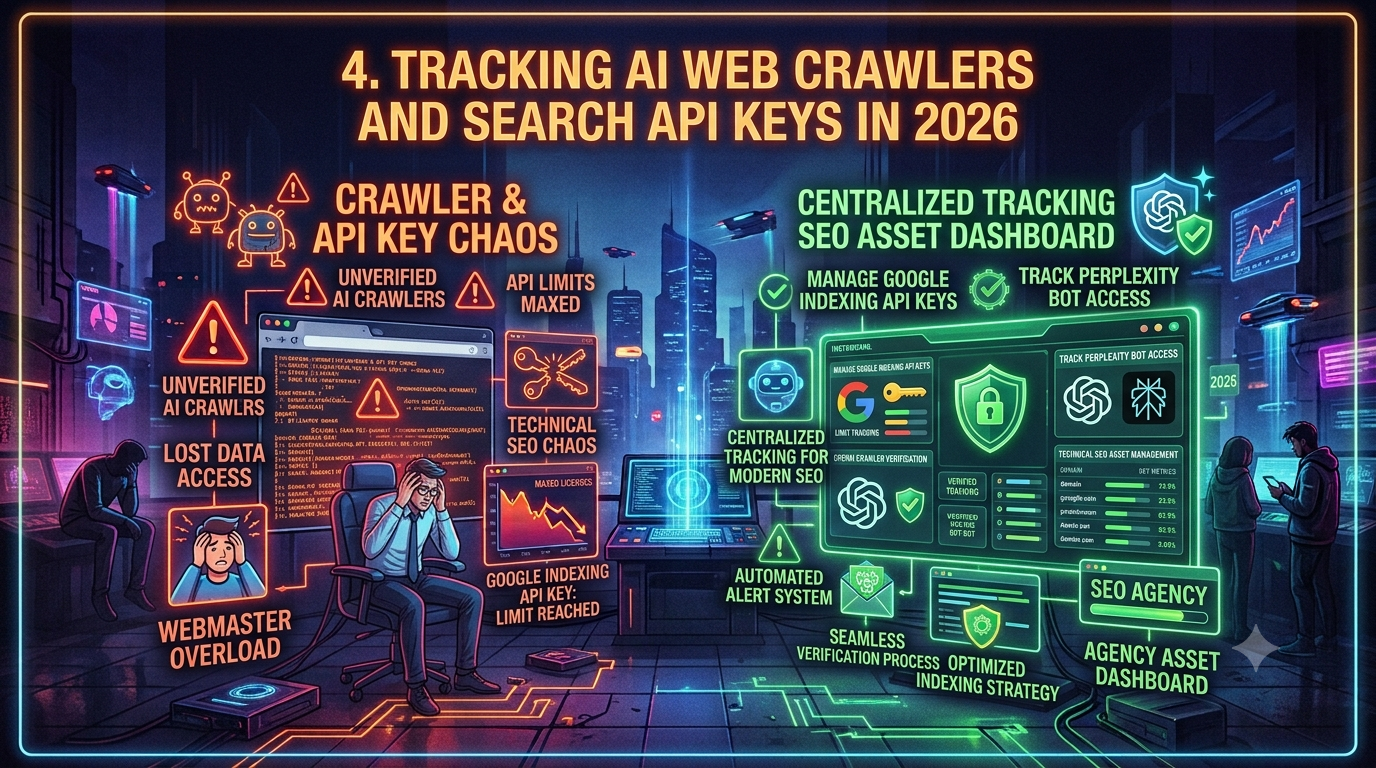
Tracking AI Web Crawlers and Search API Keys in 2026
Search engine optimization is no longer limited to rendering HTML for Googlebot and waiting for traditional crawling to catch up. The search landscape now depends on real-time data ingestion: agencies push content through programmatic APIs to capture immediate indexation while simultaneously managing a growing roster of distinct AI crawlers that power generative engines and answer platforms.
Managing this creates a genuinely complex web of technical credentials and infrastructure access. Between quota-limited indexing endpoints, per-vendor crawler verification, and multi-tenant client setups, tracking modern technical SEO assets has become its own operational discipline — and by early 2026, AI crawlers alone accounted for roughly 4.2% of all web traffic, a share that keeps climbing as more assistants add live browsing.
When agencies lose track of Google Indexing API access, OpenAI or Anthropic crawler directives, or Perplexity bot behavior, indexation stalls, quotas get silently exhausted, and brands quietly drop out of AI answer engines — often with no obvious error to alert anyone.
1. The Real-Time Indexation Landscape
In traditional SEO, crawling was passive: spiders discovered content through XML sitemaps and internal links. Today, active infrastructure management spans two distinct vectors — direct API push protocols, and the separate universe of AI answer-engine crawlers.
API-Driven Instant Indexation
Google Indexing API. This is the single most misunderstood asset in this category, so it's worth being precise. Google's own documentation states the API can only be used to request crawls for pages with JobPosting structured data or BroadcastEvent embedded in a VideoObject — job boards and livestream pages, full stop. It is not officially supported for blog posts, product pages, or general content, and Google representatives have repeatedly said so in public forums, warning that broad misuse looks like spam behavior. In practice the API will accept and return a 200 for almost any URL, which is exactly why so many WordPress plugins and SEO tools use it off-label — but Google gives no guarantee that off-label submissions do anything, and reserves the right to revoke access. The default quota is 200 publish requests per day per Cloud project, and — notably — job boards report that requests for a quota increase have gone largely unanswered throughout 2026. Agencies running legitimate job or event platforms should still use it; agencies pushing ordinary content through it should treat it as an unsupported crawl hint, not a discovery strategy.
Bing IndexNow Protocol. IndexNow is an open, free protocol — originally built by Bing and Yandex, now also consumed by Seznam, Naver, and Yep — that instantly notifies participating engines when a URL is created, updated, or deleted. It requires hosting a generated key as a plain-text file at the domain root and keeping that file in sync across every environment. One important correction: Google does not consume IndexNow. Google evaluated it after the 2021 launch and never adopted it; Google-side discovery still runs through sitemaps, internal linking, and the Indexing API above. Where IndexNow earns its keep for AI visibility is indirectly — Bing's index is a backbone data source for several AI answer surfaces, including Copilot and, at times, ChatGPT Search and Perplexity, so a clean IndexNow setup has more downstream reach than the Bing-only framing suggests.
AI Search Engines and LLM Fetchers
Generative engines run distinct crawlers and live-fetch agents that must be identified, verified, and controlled independently. The original three-vendor list undersold how granular this has gotten — each major lab now runs multiple, separately-controllable bots:
| Operator | User agent | Purpose | Robots.txt behavior |
|---|---|---|---|
| OpenAI | GPTBot | Model training data collection | Respected |
| OpenAI | OAI-SearchBot | Indexing for ChatGPT Search citations | Respected |
| OpenAI | ChatGPT-User | Live fetch when a user asks ChatGPT to read a page | OpenAI's own docs now describe this as user-initiated fetching that may not be governed by robots.txt the same way a crawler is — treat it as closer to a browser request than a bot you can fully gate |
| Anthropic | ClaudeBot | Model training data collection | Respected |
| Anthropic | Claude-SearchBot | Indexing to improve Claude's search answers | Respected |
| Anthropic | Claude-User | Live fetch when a user asks Claude to read a page | Respected |
| Perplexity | PerplexityBot | Builds Perplexity's core search index | Claims to respect it — see the case study below |
| Perplexity | Perplexity-User | Live fetch triggered by a user's question | Claims to respect it |
This is a meaningful correction to how these vendors are usually described: Anthropic runs three separate crawlers, not one. ClaudeBot, Claude-SearchBot, and Claude-User each need their own robots.txt directive — blocking ClaudeBot stops training-data collection but has no effect on whether Claude can fetch a page live when a user asks about it, or on Claude's own search index.
Beyond the "big three," agencies managing larger portfolios increasingly need to account for Google-Extended (Google's AI-training opt-out token, separate from regular Googlebot), Applebot-Extended (Apple Intelligence training opt-out), Amazonbot (Alexa and Amazon AI surfaces, which opts out per-page via a noarchive meta tag rather than a robots.txt block), Meta-ExternalAgent (Meta AI training), and CCBot (Common Crawl, whose corpus is reused by several other AI labs). Two frequently-cited crawlers — ByteDance's Bytespider and xAI's Grok crawler — currently have no official vendor documentation page at all, which is itself worth logging as a known gap.
2. Critical Assets and Potential Failure Points
Managing technical SEO assets across a portfolio of 50 to 200 client domains creates silent points of failure. When credentials decay or bot directives misfire, search visibility drops without throwing a traditional site error.
                    ┌─────────────────────────────────────────┐
                    │      Technical SEO Credentials           │
                    └────────────────────┬────────────────────┘
                                          │
                 ┌────────────────────────┴────────────────────────┐
                 ▼                                                  ▼
    ┌──────────────────────────┐                     ┌──────────────────────────┐
    │     Search API Keys       │                     │    AI Bot Access Control │
    └────────────┬──────────────┘                     └────────────┬─────────────┘
                 │                                                  │
    ┌────────────┴────────────┐                       ┌────────────┴────────────┐
    ▼                         ▼                       ▼                         ▼
  Quota          Undetected Never-Expiring            Spoofed / "Stealth"    Accidental Disallow
 Exhaustion       Service Account Keys                Crawlers               (Block AI Visibility)
A. The Real Service Account Key Risk
The common assumption is that Google Cloud service account keys carry a built-in expiration that quietly lapses. That's backwards. By default, GCP service account keys never expire — they remain valid indefinitely until someone manually deletes them, which is precisely why Google now recommends against creating them at all in favor of Workload Identity Federation, attached service accounts, or short-lived OAuth 2.0 access tokens (1 hour by default, extendable to 12 hours via organization policy). If an agency does need a long-lived key for a legacy integration, Google's own guidance is to set an explicit key-lifetime policy — via the iam.serviceAccountKeyExpiryHours organization policy constraint — rather than rely on a default that doesn't exist. Left unmanaged, a never-expiring key that a former developer downloaded three years ago is a bigger liability than a key that silently expired, because nothing forces anyone to notice it.
B. Spoofed User-Agents vs. Reverse DNS Verification — and a Real-World Failure
Because AI crawlers carry real brand value (citations in Perplexity, appearances in ChatGPT Search), malicious scrapers regularly spoof user-agent strings like GPTBot/1.2 or PerplexityBot/1.0. Allowing a user-agent string in robots.txt is not verification — it's an honor system.
This isn't theoretical. In August 2025, Cloudflare published findings accusing Perplexity of "stealth crawling": on domains that had explicitly disallowed PerplexityBot and Perplexity-User in robots.txt and blocked their published IP ranges, Cloudflare observed Perplexity's traffic switching to a generic Chrome-on-macOS user agent and rotating through IP ranges and ASNs outside Perplexity's declared list — activity Cloudflare said it saw across tens of thousands of domains. Cloudflare de-listed Perplexity from its Verified Bots program as a result; Perplexity disputed the characterization and said its user-triggered agents shouldn't be judged by traditional crawler rules. Whatever the final read on that dispute, the operational lesson holds: a robots.txt disallow rule is a stated preference, not an enforcement mechanism, and IP-range matching alone isn't reliable either, since AI crawlers overwhelmingly run on shared AWS, GCP, and Azure address space rather than dedicated ASNs. Even Anthropic's own developer documentation for Claude-SearchBot now cautions that IP-based blocking is unreliable for this reason — and that blocking the wrong IP range can prevent a bot from even reading your robots.txt file in the first place. Forward-confirmed reverse DNS (matching a request's IP to a hostname on the vendor's domain and back again) remains the more defensible check where a vendor supports it.
C. The IndexNow Authorization File Gap
IndexNow requires a unique .txt key file at the domain root (e.g., example.com/<key>.txt). During site migrations, platform switches, or headless CMS re-architectures, these files are routinely wiped out along with everything else in the old document root. Once the key file is missing, automated IndexNow submissions fail outright, and — because IndexNow has no centralized status dashboard — nobody notices until organic traffic from Bing-fed sources dips.
3. Best Practices for Technical SEO Asset Management
Move Away From Long-Lived Master Keys
- Prefer keyless authentication. Google's current guidance is to use Workload Identity Federation, attached service accounts, or short-lived tokens wherever the workload supports it, and to reserve downloadable JSON keys for genuine legacy cases.
- Project-per-client model. Where a key is unavoidable, isolate it to a dedicated GCP project per enterprise client so one runaway script can't exhaust quota for the entire portfolio.
- Set an explicit expiry policy. Since keys don't expire on their own, apply an organization policy that forces newly created keys to expire (Google supports anywhere from 8 hours to 90 days), and track the renewal date deliberately rather than assuming decay will happen automatically.
Maintain Explicit Directives for Every Bot, Not Just the "Big Three"
Differentiate between training crawlers, live answer-engine fetchers, and search-indexing bots — for every vendor you care about, not just OpenAI:
# Allow live user queries while controlling training crawlers
User-agent: OAI-SearchBot
Allow: /

User-agent: ChatGPT-User
Allow: /

User-agent: GPTBot
Disallow: /private-data/

User-agent: Claude-SearchBot
Allow: /

User-agent: Claude-User
Allow: /

User-agent: ClaudeBot
Disallow: /private-data/

User-agent: PerplexityBot
Allow: /

User-agent: Perplexity-User
Allow: /
Note: IndexNow doesn't require any robots.txt entry — it's a separate push protocol, not a crawler you allow or block. Always cross-check suspicious traffic spikes against each vendor's official IP list (e.g., openai.com/gptbot.json, perplexity.com/perplexitybot.json, claude.com/crawling/bots.json) rather than trusting the user-agent string alone.
Centralize API Key and Bot-Directive Inventories
Maintain a single ledger documenting every API key, secret token, service account email, IndexNow key file location, and per-vendor bot directive — with the deployment environment and the owner attached. Set reminders well ahead of any self-imposed key rotation date, and schedule periodic re-verification of robots.txt bot directives after any platform migration, since those are the events most likely to silently reset them.
Watch for Cryptographic Bot Verification (Web Bot Auth)
The spoofing problem above is exactly what a new IETF effort, informally called Web Bot Auth, is trying to solve. Instead of a self-reported user-agent string, a bot signs each request with a private key (using HTTP Message Signatures, RFC 9421) and publishes its public key at a well-known URL, letting a server verify cryptographically that a request really came from the vendor it claims to. Cloudflare, Anthropic, OpenAI, Akamai, and Amazon are already enforcing it in production for some traffic even though the IETF working group — chartered in 2026 — hadn't finished formal standardization as of this writing. Adoption is uneven: Google is testing it only for its AI-browsing agent, not for core Googlebot, and coverage across smaller vendors is inconsistent. It's not a replacement for robots.txt or IP verification yet, but it's the direction enforcement is heading, and it's worth tracking which of your clients' CDN or WAF providers start supporting it.
4. Operationalizing API and Crawler Tracking with InstaRenewal
As technical SEO merges with infrastructure operations, spreadsheets stop being able to keep up with the number of keys, key files, and per-vendor directives one agency now manages. InstaRenewal's role here is specifically as a renewal-date tracker, expiration alerter, and asset/ownership record for these credentials — it complements, rather than replaces, the live monitoring, WAF configuration, and IAM tooling described above.
| Client / Domain | Managed SEO Asset | Owner | Renewal Tracking |
|---|---|---|---|
| Enterprise Client | Google Cloud service account key (Indexing API) | Dev Lead, J. Rao | Rotation policy: 90 days · Next renewal due in 45 days |
| E-Commerce Brand | IndexNow key file | Agency SEO Team | Last manually re-verified: Aug 12 · Recheck scheduled after next replatform |
| SaaS Platform | Perplexity bot directive (robots.txt + WAF allowlist) | Technical SEO Lead | Directive last reviewed: 3 weeks ago |
| Media Publisher | OpenAI bot directives (GPTBot / OAI-SearchBot / ChatGPT-User) | Content Ops | Audit due in 14 days |
What that looks like in practice:
- Service account and API key expiration tracking. Since GCP keys don't expire on their own, InstaRenewal logs each key's creation date, owning developer, and the rotation cadence the agency has chosen — then sends reminders ahead of that self-imposed renewal date so a key doesn't sit unrotated for years by default.
- IndexNow key file review reminders. Rather than continuously polling every client's key-file endpoint, InstaRenewal keeps a record of each domain's key file location and the date it was last manually verified, with a recurring reminder to re-check after any CMS migration, replatform, or DNS change — the events that most often wipe the file.
- AI bot directive and verification records. For each domain, InstaRenewal stores which crawlers are allowed or blocked, when that directive was last reviewed, and links to each vendor's published IP or key reference — so a team member can answer "why did this client drop out of Perplexity citations" by checking a record instead of re-researching it.
- Ownership and handoff records. Every API key, service account, and verification file tied to a domain is logged with an owner and a renewal history, so onboarding or offboarding a developer or a client doesn't leave an orphaned, unrotated credential behind.
InstaRenewal doesn't perform live HTTP monitoring of key endpoints, enforce IAM permissions, or replace a WAF's bot-verification logic — those stay with the platforms built for that job. What it prevents is the more mundane failure mode: nobody remembering a credential exists until the day it causes a problem.
5. Where This Is Headed
By 2026, technical SEO is functionally an infrastructure discipline. Securing visibility means managing the credentials and directives that feed data to traditional search indexes, generative answer engines, and the growing set of AI agents that fetch pages live on a user's behalf — while the verification layer itself (cryptographic bot auth, tighter key-lifecycle defaults) keeps shifting under agencies' feet.
Agencies that track these assets deliberately — rather than relying on defaults that don't actually protect them, or user-agent strings that can be spoofed — are the ones that stay indexed, cited, and visible as the list of engines and agents keeps growing.
---
Sources referenced: Google Search Central (Indexing API documentation), Google Cloud IAM documentation, IndexNow.org, Anthropic developer documentation, OpenAI developer documentation, Perplexity crawler documentation, Cloudflare's August 2025 report on Perplexity crawling behavior, and IETF Web Bot Auth working group materials.