
Managing domain names for a handful of clients is simple. Managing hundreds of domains across multiple registrars, legacy hosting setups, and varying billing cycles is where operational edge cases turn into late-night emergencies.
When a domain renewal slips through the cracks, the fallout rarely stops at a parked webpage. Email routing halts, API integrations time out, and certificate renewals that rely on domain validation fail. Custom nameserver infrastructure can also collapse across entirely separate client properties. Explaining why a $15 domain now costs well over $100 to recover, or why a healthy web server suddenly vanished from the internet, often leaves agencies on the defensive.
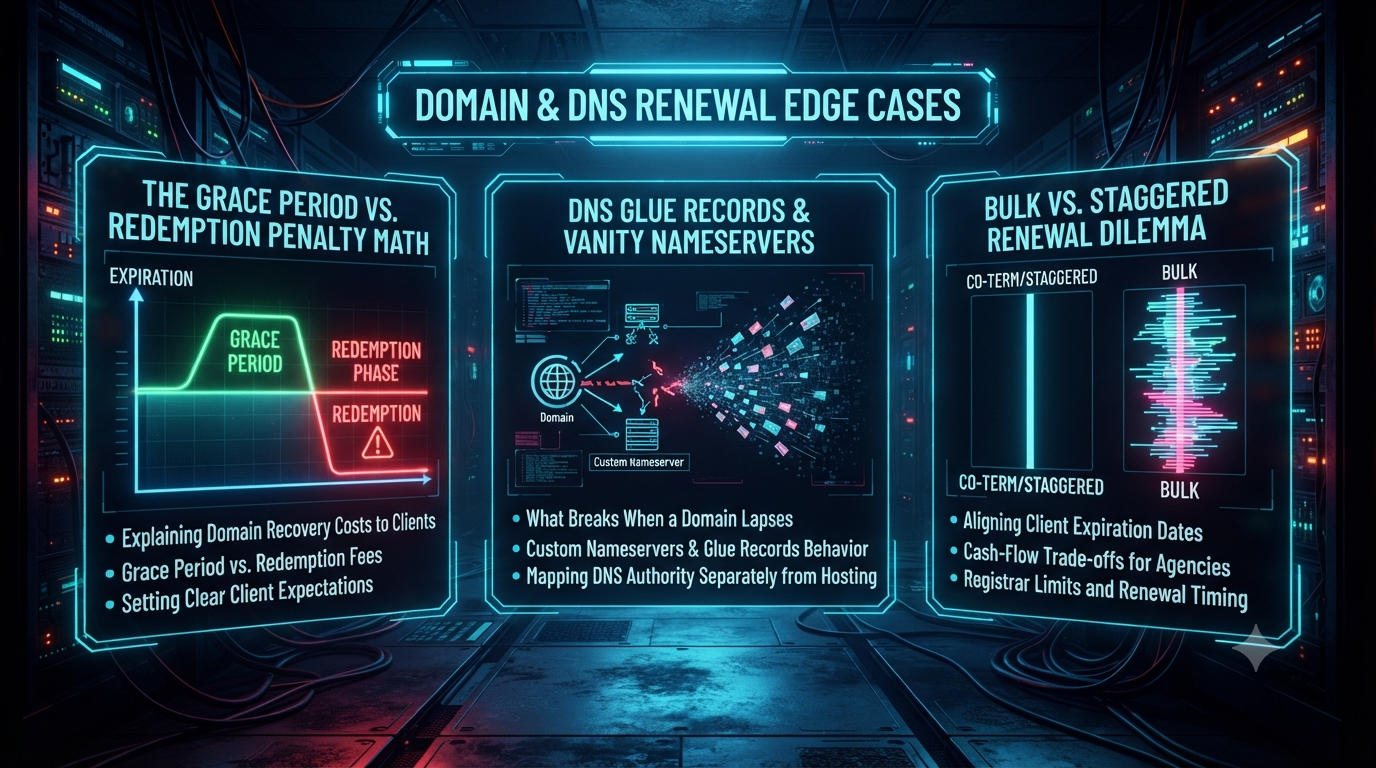
This guide covers three commonly misunderstood domain and DNS renewal edge cases: the ICANN expiration lifecycle and its costs, glue records and vanity nameservers, and the limits of aligning (co-terming) renewal dates. It includes the current timelines, technical failure modes, and portfolio management strategies.
1. Grace Period vs. Redemption Penalty: Explaining Recovery Costs After a Missed Renewal
When a client misses a domain renewal, the first question is almost always: “Why does it cost $100+ to renew a domain that normally costs about $15 a year?”
To answer that without sounding like you’re padding an invoice, separate ordinary renewal pricing from the restoration fees that apply once a deleted domain enters the redemption period. The rules below apply to generic top-level domains (gTLDs) such as .com, .net, and .org. They come from ICANN’s Expired Registration Recovery Policy (ERRP) and the registry agreements.
The Lifecycle Is Not a Fixed 80-Day Calendar
A common simplification is that every expired .com moves through the same fixed day-numbered schedule. In reality, the registrar decides when the domain is deleted, and the registry rules apply from that point on.
- Active registration: The domain resolves normally. Under the ERRP, registrars must send expiration reminders about one month and one week before expiry, plus a further notice after expiration.
- Auto-renew grace period (0 to 45 days after expiry): If the registrar neither renews nor deletes the domain, the registry automatically adds a year and bills the registrar. The maximum length of this period is 45 days. The registrar can delete the domain earlier and receive a credit for the auto-renew fee. Registrars set their own windows. Cloudflare Registrar, for example, documents a 40-day grace period for most TLDs. During this stage the registrant can usually still renew at the standard price, but the domain may be suspended, parked, or even listed for auction depending on the registrar’s terms.
- Redemption Grace Period (30 days after deletion): Once the registrar deletes the domain, the registry must offer a 30-day RGP. The ERRP requires the registry to disable DNS resolution during this period, so web, email, and anything else depending on the domain stops working. Restoration goes through the registrar and carries a restoration fee on top of renewal.
- Pending delete (5 days): After the RGP, the domain cannot be renewed or restored by anyone. It is then released for re-registration.
Because the registrar chooses the deletion day, the maximum path from expiry to release is 45 + 30 + 5 = 80 days, but many registrars release sooner. Using Cloudflare’s documented schedule, redemption runs from day 41 to day 70, pending delete covers days 71 to 75, and the domain is released after that. Always check your registrar’s published schedule rather than assuming 80 days.
Domain Recovery Cost & Timeline Breakdown
| Lifecycle Phase | Typical Timeline | DNS & Email Status | Who Acts | Typical Client Cost |
|---|---|---|---|---|
| Before expiry | Up to day 0 | Active | Standard renewal | Normal renewal fee |
| Auto-renew grace | Day 0 up to 45 (registrar-defined) | Varies by registrar; the ERRP requires registrars to interrupt service before deletion | Registrar renews or deletes | Normal renewal fee (some registrars add late fees) |
| Redemption Grace Period | 30 days after deletion | DNS disabled by the registry | Registrar submits a restore request to the registry | Renewal plus a restoration fee, which varies by registrar and TLD |
| Pending delete | Final 5 days | Offline | Nobody can act | Not recoverable; the domain must be backordered or re-registered |
What Restoration Actually Costs
Retail restoration fees vary by registrar and TLD. Published examples show the range:
- Hostinger’s published policy lists a redemption fee of $80 for most domains, plus the renewal fee and VAT. Some TLDs cost more, such as $180 for
.com.co. - Network Solutions lists a $99 redemption fee plus a $35.99 reinstatement fee.
- Cloudflare says a restore fee applies in most cases, varies by TLD, and is shown separately from the renewal fee before you confirm.
A reasonable client-facing framing is “renewal plus a restoration fee that is often in the range of roughly $80 to $180 or more.” Quote the actual figure from your registrar’s price list rather than a generic number. For context, Verisign’s wholesale price for .com rose from $10.26 to $10.97 on November 1, 2026. Its wholesale price for .net is scheduled to rise from $10.91 to $12.00 on March 1, 2027.
When Does an Expired .com Actually Drop?
Verisign changed its drop timing recently. Effective October 1, 2026, .com and .net domains begin dropping around 12:00 UTC. That is 8:00 AM Eastern during daylight saving time and 7:00 AM during standard time. Older guides that cite an afternoon Eastern or late-morning Pacific drop window are out of date. Drop-catching services want orders in early, so the practical effect for agencies is that “we’ll check on it after lunch” is no longer a plan.
Country-Code TLDs (ccTLDs) Follow Their Own Rules
Do not assume .com rules apply universally. Country-code registries set their own policies.
- `.uk` (Nominet): Registrants have 30 days after expiry to renew. If the domain is not renewed, it is suspended and stops working for 60 more days, during which it can still be recovered by renewing through a registrar. Nominet then cancels it, so the domain is renewable for up to about 90 days after expiry.
- `.io`: Timelines depend on the registrar. Amazon Route 53 documents late renewal until 44 days after expiry, restoration through the registry between days 45 and 75, and deletion from the registry at day 90.
- `.ai`: Restoration can be pricey. Spaceship’s published redemption price list shows
.aiat $165.60 against $41.40 for several other extensions, though that is one registrar’s list and others differ. - `.de` (DENIC): The registry has a 30-day Redemption Grace Period after deletion, during which the domain is not in the zone and only the former holder can restore it. If a provider stops administering a domain, DENIC’s TRANSIT service contacts the holder by postal letter, which means outdated contact details can cause a real loss.
How to Set Client Expectations Before Penalty Territory
Agencies get burned when clients treat domain renewals like routine software subscriptions that can sit unpaid for six weeks. Three operational guardrails help:
- Show the pass-through cost structure upfront. Include the lifecycle table in your onboarding packet or master services agreement (MSA). When a client sees in writing that restoration fees are set by the registry and registrar rather than by you, pushback usually softens.
- Bill early, pay early. Invoice the client 45 to 60 days before expiration. Set an internal rule to pay the registrar at roughly 15 days before expiry for mission-critical domains, and treat late client payment as a collections issue rather than risking a drop.
- Separate campaign domains from core infrastructure. Have clients classify their portfolio annually. Core domains (main website, corporate email, authentication endpoints) should be locked on auto-renew. Marketing microsites can go on manual approval with explicit sign-off that missing the deadline forfeits the asset.
2. DNS Glue Records & Vanity Nameservers: What Breaks When a Nameserver Domain Lapses
One of the hardest outages to explain to a non-technical stakeholder happens when Client Site B goes down because the domain behind Client Site A’s nameservers expired. Client B’s own domain is fully paid and its server is running without errors.
This failure occurs when an agency or legacy IT provider uses vanity nameservers (also called custom or private nameservers) built on its own domain, which depend on glue records.
How Glue Records and Vanity Nameservers Work
When a user visits example.com, a recursive resolver starts at the root servers. The root servers refer it to the .com registry servers, and those return the NS records for example.com, for instance ns1.cloudflare.com. Because cloudflare.com is outside example.com’s own zone, the resolver can look up that nameserver’s IP address separately and continue.
Many agencies instead brand their infrastructure with vanity nameservers on their own domain:
- Agency domain:
agencydns.com - Custom nameservers:
ns1.agencydns.comandns2.agencydns.com - Client domain (
clientbrand.com) points its NS records to those two hosts.
When a nameserver sits inside the very domain it serves, the resolver cannot find the nameserver’s IP without already knowing where to ask. Glue records break that loop. They are IP addresses for the nameservers, stored as host objects at the registry and published in the parent TLD zone. The registry’s response effectively says: “Ask ns1.agencydns.com, and here is its IP address so you don’t have to look it up.”
What Happens When the Nameserver Domain (agencydns.com) Lapses?
Exactly how this plays out depends on the registrar and the registry, but the dependency chain is clear:
- The grace window is unpredictable. During the registrar’s auto-renew grace period, behavior varies. Some registrars swap in parking nameservers or place the domain on hold. If the glue stays published, your servers may keep answering and client sites can appear fine. If it doesn’t, they fail. Cached delegations can make the failure roll out unevenly, so some users see an outage while others don’t.
- Deletion removes the nameservers. Per RFC 9874 (the IETF best-practice document on deleting domain and host objects), deleting a domain object makes all nameservers on its subordinate host objects unresolvable. Once
agencydns.comis deleted and enters the redemption period, DNS resolution for it is disabled. - Every dependent client domain is affected at once. Every client domain delegated only to
ns1.agencydns.comandns2.agencydns.comcan lose DNS resolution: websites, inbound and outbound email, and any other record type. This happens even if the client domains are paid up and the servers are healthy.
The Sacrificial Nameserver Problem
Registry systems generally won’t let a registrar delete a domain while subordinate host objects are still in use by domains at other registrars. To get around this, some registrars rename the host objects to a “sacrificial” nameserver on a different domain so the expired domain can be deleted.
ICANN’s Security and Stability Advisory Committee (SSAC) published SAC125 in May 2024 on the risk this creates: if the sacrificial nameserver’s parent domain is registrable, an attacker can register it and take over DNS resolution for the client domains still pointing at it. RFC 9874, published in September 2025, says renaming hosts to external, presumed non-existent hosts must not be used. It recommends alternatives such as a client-maintained sacrificial nameserver or a reserved special-use domain like sacrificial.invalid.
The agency takeaway is that a lapsed vanity-nameserver domain is not only an uptime risk. It can become a security risk for every client domain delegated to it. Periodically check which of your client domains point to nameservers you don’t recognize.
Registrar Transfers and Glue Records
Treat any transfer involving a nameserver domain as a change window. The domain’s host objects and glue IPs are managed through each registrar’s own interface, and the tooling varies. Before and after any transfer:
- Record the glue IPs exactly as shown at the old registrar.
- Confirm the same host records exist at the new registrar afterward.
- Re-test resolution for a sample of dependent client domains.
Also note that ICANN’s Board adopted the Transfer Policy Review recommendations on June 7, 2026. The recommendations would cut the 60-day post-registration and post-transfer lock to 30 days and remove the 60-day lock after a change of registrant. Until ICANN implements the new consensus policy, assume the current 60-day locks still apply.
Why Agencies Must Map DNS Authority Separately from Hosting
A common agency mistake is bundling “Hosting & DNS” into one line item on client architecture diagrams. In modern infrastructure, the registrar, DNS authority, and web/application hosting are three independent failure domains:
- Avoid self-hosted vanity nameservers unless there is a clear business reason. Use an established managed DNS provider with a redundant, globally distributed network.
- If you must use vanity nameservers, protect the parent domain. Register it for multiple years, keep it on auto-renew with a payment method that won’t expire, and ask your registrar about registry lock.
- Maintain a dependency matrix. For every client, document four distinct control planes:
- Registrar: Who holds legal custody and billing of the domain?
- Authoritative DNS: Where do the NS records point, and who has login access to the zone editor?
- Glue / host objects: Does this domain or any downstream domain depend on custom host records?
- Service endpoints: Where do the A, AAAA, CNAME, and MX records point?
- Check delegation before transfers. Run
dig +trace example.comto see the delegation chain from the root down. To see whether the registry is supplying glue, query a TLD server directly without recursion, for exampledig +norecurse @a.gtld-servers.net ns1.agencydns.com A, and inspect the answer and ADDITIONAL sections.
Certificates Raise the Stakes
Public TLS certificates are now capped at 200 days under CA/Browser Forum Ballot SC-081v3, which took effect March 15, 2026. The maximum falls to 100 days on March 15, 2027 and to 47 days on March 15, 2029. Domain validation reuse shrinks on the same schedule, to just 10 days by 2029. As certificate lifetimes shrink, the DNS and domain control that certificate issuance depends on is exercised more often, so a lapsed registration or broken delegation will surface in failed renewals sooner.
3. Bulk vs. Staggered Renewals: Should Agencies Align Client Expiration Dates?
When an agency takes on a client with 15, 50, or 200 domains, the portfolio usually arrives with expiration dates scattered across the whole year. The result is dozens of small invoices, fragmented approvals, and constant background risk of an overlooked notice. The obvious fix is co-terming: aligning expiration or renewal dates to a single target date, such as the client’s fiscal year-end or retainer renewal.
Co-terming domains, however, works very differently from co-terming SaaS licenses.
How Domain Co-Terming Actually Works
Unlike software vendors that prorate by the day, domain registries extend registrations in whole-year increments, from 1 to 10 years. You cannot pay a registry for four months of a .com. Any tool that “syncs” renewal dates is therefore a registrar-level feature, and how it works varies:
- GoDaddy’s ConsoliDate synchronizes renewal dates for
.comand.netdomains only. You pick a new renewal date that falls beyond the current expiration of all selected domains, and a domain can only be consolidated once per year. - NameSilo handles synchronization through a support ticket rather than a self-service tool. It calculates a prorated, partial-year fee for each domain to bridge to the shared target date.
Because the mechanics differ, ask your registrar two questions before you commit: what the registry expiration date will be after the sync, and what you will be charged to get there.
Bulk Co-Termed vs. Staggered Renewals: Strategic Comparison
| Evaluation Factor | Bulk / Co-Termed Renewals | Staggered (Natural) Renewals |
|---|---|---|
| Administrative overhead | Low. One annual audit, one client sign-off, one consolidated invoice. | High. Ongoing monitoring, repeated approval loops, and many small invoices. |
| Cash-flow impact | Spiky. A large lump sum on one date. For scale, 200 domains at about $15 each is roughly $3,000. | Smooth. Spreads spending across the year. |
| Blast radius of a missed payment | Large. If one bulk payment fails or a purchase order stalls, the whole portfolio can enter grace and redemption at once. | Contained. A billing hiccup affects only the domains expiring that month. |
| Portfolio pruning | Easier. Forces an annual review where unused campaign domains can be dropped. | Harder. Small invoices get rubber-stamped, which leads to domain bloat. |
| Registrar & TLD compatibility | Restricted. Sync tools are registrar-specific and often limited by TLD (GoDaddy’s covers only .com and .net). | Universal. Works at every registrar and registry. |
Technical & Registrar Limits on Co-Terming
Before promising a client that you’ll consolidate an entire portfolio onto one renewal date, account for these constraints:
- The 10-year ceiling. A gTLD registration’s total term cannot exceed 10 years. A renewal that would push the expiration past that cap fails.
- The 60-day transfer lock. Under the current ICANN Transfer Policy, a domain generally can’t be transferred between registrars within 60 days of initial registration or a previous transfer. Consolidating registrars can mean waiting out that window. As noted above, the policy is slated to change, but the new rules are not yet in force.
- Different TLDs, different rules. Registration terms and renewal behavior vary by registry. For example, OVHcloud lists
.deregistration and renewal periods as one year, while.ukallows 1 to 10 years. A single renewal date across a global brand portfolio is rarely fully achievable. Expect one primary aligned date for the TLDs your registrar supports and a tail of exceptions. - Limited refunds. Registry-level credits exist only for deletions within the grace periods. The Verisign registry specification, for example, credits registrars for domains deleted within the add, renew, and auto-renew grace periods, and the renew grace period is 5 days. If a client leaves three months after you’ve co-termed 80 domains, you generally can’t recover unused time through the registry.
- Price changes affect timing. Registry wholesale prices are changing:
.comwent up on November 1, 2026, and.netfollows on March 1, 2027. Under Verisign’s.comagreement, further increases of up to 7% a year are possible in the remaining years of the current pricing period. Ask your registrar how a renewal or multi-year extension processed before an increase is priced, because a sync date chosen around a price change can matter for large portfolios.
The Hybrid Recommendation for Agencies
For multi-domain clients, neither pure staggered chaos nor an all-or-nothing renewal date is ideal. As a rule of thumb (a judgment call, not a standard):
- For small portfolios (roughly under 15 domains): Keep natural staggered dates, lock all domains on auto-renew, and bill the client once a year from an estimated domain budget, true-ing up any variance at year-end.
- For larger portfolios: Co-term the secondary, defensive, and marketing domains to a single annual review date, ideally 60 days before the client’s fiscal year-end so unused domains can be pruned before budgets reset. Keep mission-critical production domains on multi-year registrations, within the 10-year cap and your registrar’s limits, so a single billing failure can’t put them in grace.
Agency Domain & DNS Renewal Audit Checklist
Use this checklist during client onboarding and quarterly infrastructure reviews to eliminate renewal blind spots:
- Verify legal registrant ownership. Confirm the client’s legal entity (not a former freelancer or agency employee) is listed in the registrant contact fields, and document who controls the registrant email address.
- Audit nameservers and glue. For every production domain, identify the authoritative nameservers. Flag any that sit on a different domain than the one being served, and verify where that nameserver domain is registered and when it expires.
- Classify domain tiers. Tag every domain as Tier 1 (mission-critical: web, email, authentication), Tier 2 (active marketing and redirects), or Tier 3 (defensive or parked).
- Add multi-year buffers for Tier 1. Renew Tier 1 domains for multiple years where your registrar supports it, so one expired payment card never puts production traffic near suspension.
- Document non-standard TLD rules. Flag any
.io,.ai,.co,.de,.uk, or other ccTLDs with their specific grace periods, restoration fees, and contact requirements. - Record your registrar’s actual lifecycle. Write down each registrar’s auto-renew grace length, deletion day, and restoration fee instead of relying on the 80-day maximum.
- Align billing lead times. Invoice clients 45 to 60 days before expiry and schedule registrar payment about 15 days before expiry.
- Review nameserver-domain protection. Confirm any domain providing vanity nameservers is on auto-renew, on a long registration term, and covered by registry lock where available.