
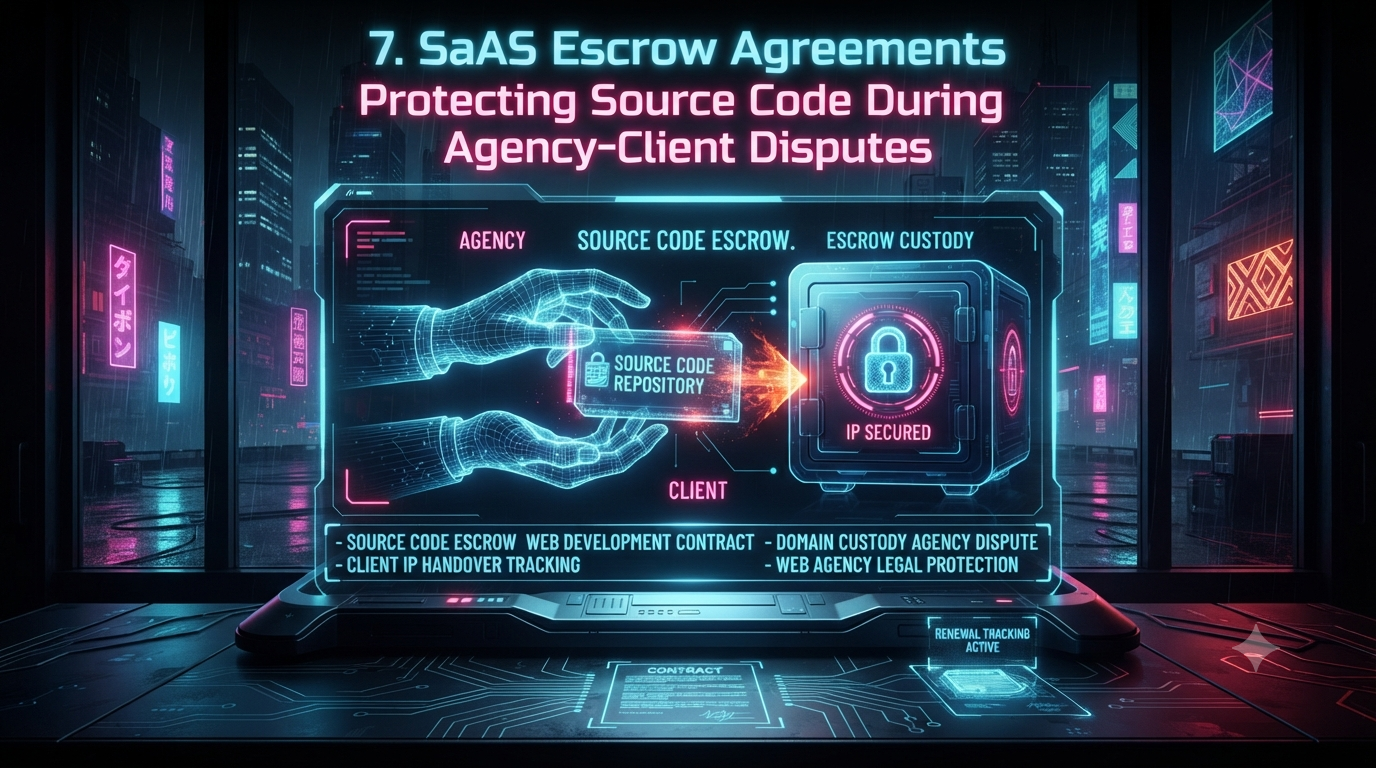
SaaS Escrow Agreements: Protecting Source Code During Agency-Client Disputes
When a digital agency or software consultancy closes a large custom-development contract, the relationship starts with alignment and enthusiasm. Enterprise procurement teams and client legal counsel, however, plan for the opposite case. They don't draft contracts for the best outcome — they draft them for insolvency, breach of contract, or a relationship that goes sideways.
The mechanism enterprise clients increasingly use to hedge against that risk is the software (or source code) escrow agreement: a tripartite legal arrangement where a neutral third party holds the application's source code, build instructions, and — increasingly — infrastructure configuration and credentials. If the agency shuts down, abandons the project, or falls into an unremedied material breach, the escrow agent releases those materials directly to the client.
For agencies, this arrangement is manageable — but only if it's tracked properly. Deposit schedules, verification obligations, and domain/asset custody all carry deadlines and legal weight. Letting any of them lapse can mean forfeited leverage, an unwarranted code release, or direct legal exposure.
1. The Tripartite Structure: How Software Escrow Works
A software escrow agreement involves three distinct parties:
- The Depositor (the agency or developer) — builds the software and deposits source code, environment configuration, and documentation into the escrow account.
- The Beneficiary (the client) — pays for the development and holds the right to claim the deposited materials if a defined release event occurs.
- The Escrow Agent — a neutral third party that holds the deposit, verifies its contents, and administers release requests according to the agreement.
┌─────────────────┐       Code Deposits & Updates        ┌──────────────────┐
│   Web Agency     ├─────────────────────────────────────►│   Escrow Agent   │
│   (Depositor)    │◄─────────────────────────────────────┤ (Neutral Vault)  │
└────────┬─────────┘      Audit Fees & Verification        └────────┬─────────┘
         │                                                          │
         │  Development Contract                                   │  Release Trigger
         │  & Payment Milestones                                   │  (Insolvency / Breach)
         ▼                                                          ▼
┌──────────────────┐                                       ┌──────────────────┐
│ Enterprise Client │◄──────────────────────────────────────┤  Code & Keys     │
│  (Beneficiary)    │      Escrow Beneficiary Designation    │    Released      │
└──────────────────┘                                        └──────────────────┘
Who actually provides this service today? The market has consolidated significantly. Iron Mountain sold its intellectual-property-management (software escrow) business to NCC Group in 2021 for roughly $220 million gross; NCC rebranded that division as Escode. In May 2026, NCC Group in turn sold Escode to funds managed by TDR Capital at a £275 million enterprise value — meaning the "Iron Mountain escrow" many agencies still reference by habit has changed hands twice since 2021. Other active providers agencies encounter include Vaultinum, Codekeeper, Praxis Technology Escrow, EscrowTech International, and Escrow4all, among others tracked in current market reports. If a client's contract still names "Iron Mountain" as the escrow agent, it's worth confirming which entity actually holds the deposit today.
2. From Source Code Escrow to SaaS and AI Continuity Escrow
Traditionally, escrow agents held little more than a zip file or Git mirror of source code. For a modern web application, raw source code is close to useless without the surrounding environment. Enterprise clients now typically expect a broader deposit sometimes called SaaS continuity escrow, covering:
- Source code and build instructions — compiled code, scripts, and dependencies needed to build the application.
- Infrastructure as Code (IaC) — Terraform, Dockerfiles, Kubernetes manifests, and other assets needed to rebuild the cloud environment.
- Database schemas and backups — structural schemas (and sometimes anonymized data) needed to restore state.
- Administrative access — documentation of DNS, SSL/TLS, API gateway, and third-party integration ownership, so the client knows what exists even if credentials themselves are handled separately.
A newer wrinkle: AI escrow
If your agency builds features on top of fine-tuned models, custom training pipelines, or agentic workflows for clients, escrow demands are starting to extend there too. A 2026 industry guide on software escrow notes that AI-dependent applications require their own asset category — model weights and parameters, training data schemas, hyperparameters, and the hardware/CUDA configuration needed to rebuild the environment — because none of that is captured by a conventional source-code deposit. Several escrow vendors (Codekeeper and Praxis among them) now offer dedicated "AI escrow" products covering model versions, weights, training data, system prompts, and fine-tuning configuration. If your agency is shipping AI-powered functionality as part of a client deliverable, it's worth checking whether the client's escrow rider already assumes this coverage — many older contract templates don't.
3. Release Triggers: When Does the Client Actually Get the Code?
An escrow agreement doesn't give the client standing access to the agency's IP. Materials stay locked in the vault unless a defined release event occurs. Legal counsel should draft these triggers narrowly, since a loosely worded trigger can be misused during an ordinary billing dispute.
Standard, legitimate triggers:
- Insolvency or bankruptcy — the agency files for bankruptcy protection, enters liquidation, or otherwise becomes legally unable to continue operating.
- Product or support abandonment — the agency stops maintaining a proprietary platform without offering a migration path.
- Material, unremedied breach — the agency fails a core obligation (uptime, support SLA, deposit maintenance) and doesn't cure it within the contractual window.
Cure periods vary by negotiation — 30 days is the most common baseline in vendor contracts generally, though some escrow-specific templates run to 60 days. It's also standard for certain categories — insolvency, IP infringement, confidentiality breaches — to carry no cure right at all, since those aren't the kind of failure a time window can fix. Agencies should push to keep the cure period on the longer end for anything short of insolvency, and confirm the trigger requires objective, verifiable proof (a court filing, a written notice with a specific defect) rather than a unilateral client assertion.
The danger zone: disputed releases and non-payment
The real risk for agencies shows up during a scope or invoice dispute. A client withholding a final milestone payment, unhappy with delivered work, may try to characterize that disagreement as a "material breach" to force an escrow release without paying. This is exactly why release triggers need to be tied to objective, evidence-based conditions, and why the agreement should require a formal, time-bound dispute-resolution step — sometimes framed as technical arbitration — before any release proceeds on a contested claim.
One correction worth flagging on the domain side specifically: agencies sometimes worry a client will invoke ICANN's UDRP (Uniform Domain-Name Dispute-Resolution Policy) over a domain held during a billing dispute. In practice, UDRP is built for trademark-based cybersquatting — the complainant has to prove the domain is identical or confusingly similar to a mark they own, that the registrant has no legitimate interest in it, and that it was registered and is being used in bad faith. An agency holding a client's domain as part of an ongoing (if disputed) service relationship generally has a legitimate business basis for that registration, which is precisely what defeats a UDRP claim — and UDRP panels can't award damages regardless. A client's more realistic remedy in a domain-custody dispute is a straightforward breach-of-contract claim or a request for injunctive relief, not a UDRP filing. Agencies should still avoid becoming the story here: clear contract language on when domain administrative control transfers (usually tied to final payment) is a better defense than relying on a dispute mechanism that likely doesn't apply.
4. Essential Clauses for Web Agency Legal Protection
The verified deposit schedule
Avoid vague language like "the agency will deposit code continuously." Continuous manual updates are an operational drain agencies rarely sustain in practice. Negotiate a fixed schedule instead — quarterly, or tied to major production releases — and where the escrow provider supports it, automate deposits via a repository integration (GitHub, GitLab, Bitbucket) so the deposit stays current without manual effort.
The cure period
As above: push for a defined written-notice-plus-cure structure for anything short of insolvency or IP/confidentiality breaches, and resist triggers that let a client unilaterally declare a breach without an objective standard.
Verification rights, correctly scoped
Enterprise clients often want assurance the deposited code actually works, not just that a file exists in a vault. Current escrow providers structure this in tiers rather than a single "verification" checkbox:
- Deposit validation — confirms the materials are present, readable, and free of obvious corruption.
- Build verification — confirms the source code actually compiles into a working application.
- Deployment verification — recreates the live environment from the deposit and confirms the application runs.
Providers typically issue a formal report (Escode's, for example, follows an ISO 9001-aligned format) documenting the result. Agencies should insist the client — not the agency — bears the cost of any verification beyond the basic deposit check, since deeper verification tiers exist for the client's assurance, not the agency's obligation.
Scope-limited license on release
The agreement should state explicitly that a release grants the client a non-exclusive, perpetual, royalty-free license to use and modify the code for their own internal operations — and nothing more. The client should be contractually barred from reselling, sublicensing, or commercializing the agency's underlying proprietary frameworks or reusable code modules.
5. Operationalizing Escrow and Asset Tracking
Across even a handful of enterprise clients, agencies end up tracking a lot simultaneously: escrow vault renewal dates, deposit milestones, domain and DNS custody, and third-party license inventories. The table below summarizes where this typically breaks down.
| Risk Category | Common Failure | Agency Impact | Prevention |
|---|---|---|---|
| Code staleness | Depositing code at signing, then never updating it | A legitimate release hands the client a broken, year-old build — inviting a dispute over whether the agency met its obligations | Tie deposits to a fixed schedule or an automated repo sync, and log every deposit date |
| Credential sprawl | Team members hold client infrastructure in personal accounts | Escrow deposit obligations can't be met cleanly; offboarding a departing employee becomes a security risk | Centralize client infrastructure access under a managed, agency-owned account structure |
| Domain custody disputes | Agency retains registrar/admin access during a billing dispute with no clear contractual trigger for transfer | Reputational damage and a breach-of-contract claim, even where a UDRP claim would likely fail | Document domain custody explicitly, and tie the administrative transfer date to a specific invoice or contract milestone |
| Unverified dependencies | Deposited code omits proprietary third-party libraries or build scripts | Deposit fails build verification, undermining the agency's claim of compliance | Maintain a build/dependency manifest alongside every deposit |
6. Where a Tool Like InstaRenewal Fits — and Where It Doesn't
It's worth being precise here, because it's easy to overstate what a renewal-tracking tool can do in an escrow context.
InstaRenewal is a manual renewal-date and ownership record-keeping platform — it covers domains, SSL/TLS certificates, hosting accounts, and plugin/software licenses. It is not a credential vault, not a live monitoring or scanning system, not an access-control (IAM) system, and not a source-code audit tool. It doesn't compute checksums, sync with Git, or enforce automated release of anything based on invoice status.
What it can reasonably do inside an escrow workflow:
- Track the escrow vault's own renewal date. Escrow agents charge ongoing maintenance fees, and missing that renewal can lapse the underlying agreement — that's a straightforward renewal-date entry, the core thing InstaRenewal is built to track.
- Record who holds domain, hosting, and SSL custody for each client engagement, and note when administrative control is contractually due to transfer (e.g., on final payment) — as a manual ownership record, not an automated enforcement mechanism.
- Keep a single, centralized reference for which client relationships involve an active escrow arrangement, so the obligation doesn't live only in one person's inbox or a buried PDF.
What it doesn't replace: the escrow agent's actual deposit verification, any cryptographic proof of deposit integrity, and any system that ties credential or code release to payment status. Those need to sit with the escrow provider and your legal counsel — a renewal tracker's job is making sure the dates around those obligations don't quietly slip.
7. Conclusion
Enterprise clients want assurance before signing large web development contracts, and escrow demands aren't going away — if anything, the scope of what's expected in a deposit (infrastructure, and increasingly AI assets) is expanding. Rather than treating escrow as a hostile legal hurdle, agencies that negotiate well-scoped triggers, realistic cure periods, and clearly tiered verification rights can use escrow as a selling point: proof the agency is a mature, enterprise-ready partner. Pairing those contractual safeguards with disciplined internal tracking of renewal dates, deposit schedules, and asset custody — using the right tool for each piece — is what keeps that promise credible when it actually gets tested.