
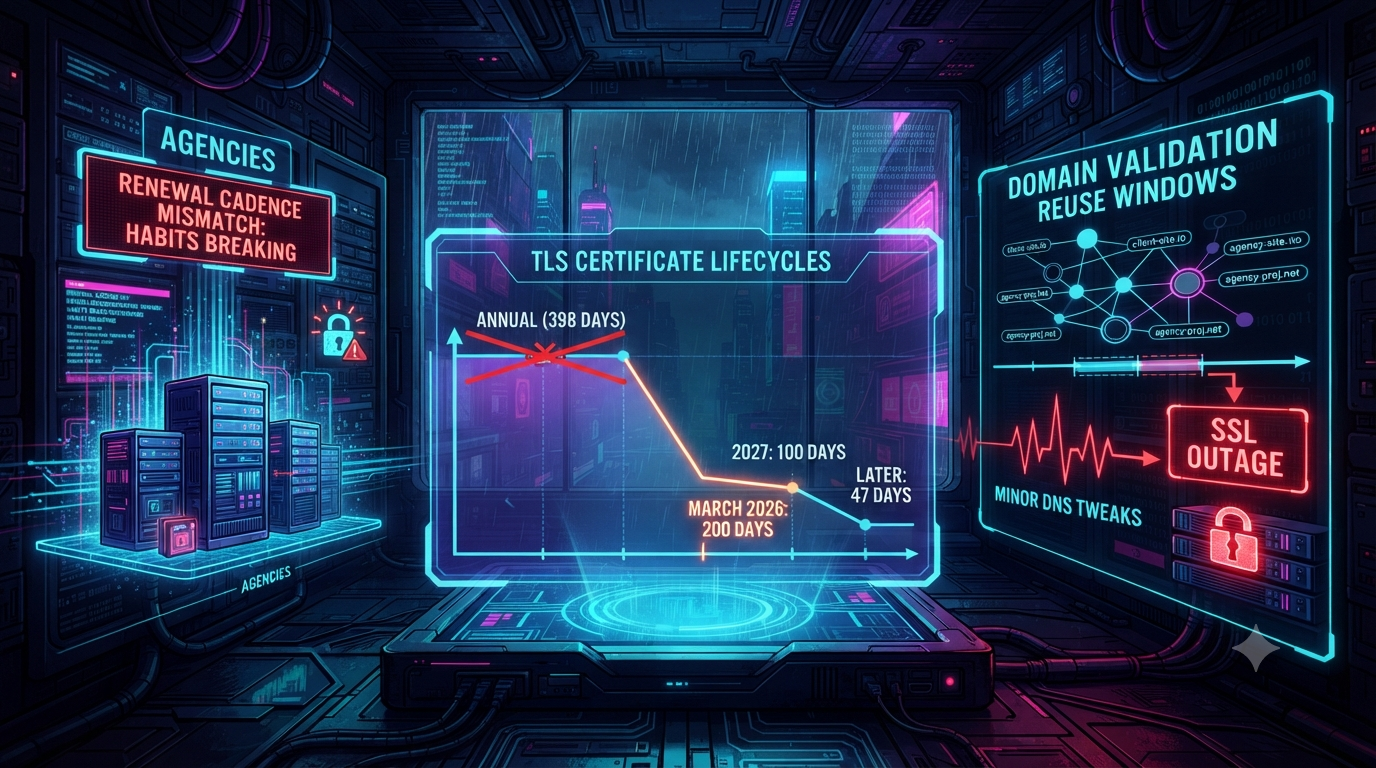
For years, web and digital agencies treated SSL/TLS certificate management as a quiet, once-a-year administrative chore. A client bought an annual certificate, or prepaid for a multi-year bundle, and someone on the operations team renewed it every twelve months, often with a calendar reminder set thirty days out. That model is breaking down. Under the CA/Browser Forum’s Ballot SC-081v3, approved in April 2025, the maximum validity period for publicly trusted TLS certificates dropped to 200 days on March 15, 2026. It falls to 100 days on March 15, 2027 and 47 days on March 15, 2029.
As 2026 draws to a close, agencies are no longer preparing for a theoretical future. The first compression step is already in force, and the 100-day step is less than four months away. Its knock-on effects are shorter renewal cadences, multi-year subscription friction and tighter domain validation reuse windows. Together they are exposing brittle workflows across client portfolios.
1. The 200-Day TLS Shift: Why Annual SSL Renewal Habits Are Already Breaking for Agencies
What Changed on March 15, 2026, and What Comes Next
Publicly trusted TLS certificates govern encryption and server identity across websites, APIs, subdomains and mail endpoints. Maximum certificate lifetimes were previously capped at 398 days (roughly 13 months). For certificates issued on or after March 15, 2026, the cap is 200 days. The ballot builds in one day of “wiggle room” in its calendar arithmetic, and some certificate authorities (CAs) take advantage of it by issuing 199-day certificates, one day under the cap.
The ballot also shortens how long a CA may reuse validation data, not just how long a certificate lasts.
| Milestone Date | Max TLS Certificate Lifetime | Max Domain / IP Validation Reuse | Max Subject Identity (OV/EV) Reuse | Operational Cadence Implication |
|---|---|---|---|---|
| Before March 15, 2026 | 398 days | 398 days | 825 days | Annual / ~13-month cycle |
| March 15, 2026 (Active) | 200 days | 200 days | 398 days | ~6.5-month cycle (roughly twice a year) |
| March 15, 2027 | 100 days | 100 days | 398 days | ~3-month cycle (quarterly replacements) |
| March 15, 2029 | 47 days | 10 days | 398 days | ~1.5-month cycle (every ~45 days) |
The ballot’s author laid out the step sizes as calendar arithmetic rather than arbitrary numbers:
- 200 days equals a maximal six-month period (184 days), plus half of a 30-day month (15 days), plus one day of buffer.
- 100 days equals a maximal three-month period (92 days), plus roughly a quarter of a 30-day month (7 days), plus one day of buffer.
- 47 days equals one maximal month (31 days), plus half of a 30-day month (15 days), plus one day of buffer.
Shorter lifetimes shrink the exposure window if a private key is compromised and reduce reliance on slow or inconsistent revocation checking. They also push the ecosystem toward greater cryptographic agility. For agencies, however, the immediate consequence is volume and frequency. A portfolio of 250 client domains, each with one certificate renewed at the maximum lifetime, needs about 230 issuances a year at 398 days. That rises to about 455 at 200 days, about 910 at 100 days and about 1,940 at 47 days. In practice, renewing before expiry (commonly around two-thirds of the lifetime) pushes those numbers higher still.
Let’s Encrypt, which issues free certificates by the millions, has announced its own schedule, and it moves faster than the CA/Browser Forum minimum. Its default “classic” profile is scheduled to move from 90-day to 64-day certificates on February 10, 2027, and to 45-day certificates on February 16, 2028. An opt-in profile for 45-day certificates has been available since May 13, 2026. Agencies whose clients use Let’s Encrypt, directly or through a host or CDN, will see shorter cycles ahead of the Forum’s own deadlines.
Why Annual Habits and Multi-Year Paid Certs Create Bottlenecks
Agencies run into trouble on two fronts when they hold onto annual habits: calendar assumptions and multi-year commercial billing.
First, hard-coded renewal schedules fail silently. Scripts or cron jobs written to renew “30 days before a 365-day expiration” or “60 days after issuance” lose their timing logic as validity shrinks. Let’s Encrypt itself warns that renewing at a hardcoded 60-day interval will no longer be sufficient once 45-day certificates arrive. Human teams accustomed to seeing an expiration date a full year out also overlook mid-year expirations. That is especially true on secondary assets such as staging portals, webhook endpoints, reverse proxies and client microsites that sit outside the primary marketing domain.
Second, multi-year paid certificates do not extend cryptographic validity beyond the CA/Browser Forum cap. Even when a client or agency pays upfront for a multi-year TLS package, the CA can only issue each individual certificate up to the current maximum lifetime. Fulfilling a multi-year order requires reissuance throughout the paid term. SSL.com, for example, tells customers on 12-month plans to expect at least one mid-term reissuance.
That creates a classic agency bottleneck:
- Billing vs. operations disconnect: Account managers and clients view a multi-year invoice as “set for two or three years,” while DevOps or support engineers still face reissuance cycles every few months.
- Re-approval friction: For Organization Validated (OV) and Extended Validation (EV) certificates, the maximum reuse period for organization (subject identity) validation fell from 825 days to 398 days on March 15, 2026. If a client company changed its legal name, registered address or corporate officers and nobody updated validation records, a reissue can stall waiting for manual verification. SSL.com’s guidance gives a concrete example: an OV certificate whose organization was validated 450 days earlier needs fresh organization validation.
- Key and CSR drift: Reissuing without automated deployment often leaves engineers manually generating Certificate Signing Requests (CSRs), downloading bundles from a vendor portal and uploading files to origin servers or load balancers. That introduces human delay and copy-paste mistakes.
Recalibrating Renewal Lead Times and Automated SSL Checks
To stop treating renewals as fire drills, agencies should treat certificate management as an ongoing operational pipeline rather than an annual event:
- Shift from fixed day offsets to ratio-based renewal windows: Rather than renewing at a static “30 days before expiry,” configure renewal automation around a fraction of the certificate’s lifetime, commonly around two-thirds. Better still, use ACME Renewal Information (ARI), standardized as RFC 9773 in June 2025, where your CA and client support it. ARI lets the CA publish a suggested renewal window for each certificate. Let’s Encrypt has supported it since March 2023 and recommends it. General ACME support does not guarantee ARI support, so confirm in your client’s documentation and logs that it is actually being used.
- Adopt ACME and automated deployment: The Automated Certificate Management Environment (ACME) protocol automates challenge completion, certificate issuance and renewal. Where legacy control panels or third-party hosts lack native ACME support, API integrations or managed Certificate Lifecycle Management (CLM) tools help close the gap.
- Expand discovery beyond primary domains: Audit every public hostname, CDN edge rule, load balancer listener, API gateway and TLS-enabled mail or app subdomain. An expired certificate on a payment callback subdomain or asset host breaks user journeys just as badly as an expired apex domain.
- Set multi-stage alerts and test reloads: Trigger warnings well ahead of expiration through actively monitored channels (such as Slack, PagerDuty or ticketing queues rather than an unmonitored billing inbox). Verify zero-downtime service reloads in staging before touching production.
2. Domain Validation Reuse Windows: How Shorter Re-Checks Turn Minor DNS Tweaks Into SSL Outages
How Domain Validation Reuse Works
Before a CA issues or reissues a TLS certificate, it must verify that the requester controls every domain name or IP address listed on the certificate. This process is known as Domain Control Validation (DCV). Common methods include HTTP file challenges, email-based validation and DNS TXT or CNAME records. Separately from DCV, CAs also check Certificate Authority Authorization (CAA) records before issuing.
Historically, once a CA verified domain control, it could reuse that result for later issuances for up to 398 days. Under the SC081v3 schedule, the maximum domain and IP address validation reuse period matches the certificate lifetime cap for the first two steps:
- 200 days starting March 15, 2026
- 100 days starting March 15, 2027
- 10 days starting March 15, 2029, even though the maximum certificate lifetime at that point is 47 days
Each name on a certificate is validated individually. On a wildcard certificate, the wildcard (*.example.com) and the base domain (example.com) each need their own valid DCV. A domain validated for last year’s certificate will almost always fall outside the 200-day window by renewal time, so reissuance increasingly coincides with fresh domain re-verification. By 2029, the validation window will be shorter than the certificate itself, and domain control will effectively be re-proved at every renewal.
One development worth tracking is persistent DCV, added to the Baseline Requirements by Ballot SC-088v3 in November 2025. It allows ongoing re-validation against a single DNS TXT record published once, without a DNS change at each renewal. CA support is still rolling out, so ask your CA whether and when it offers it.
Why Minor DNS or Hosting Changes Trigger Outages Before Reissue
In an annual-renewal era, a routine DNS edit or hosting migration frequently happened months away from certificate renewal, giving teams plenty of time to notice broken challenges. With 200-day lifecycles, and much tighter reuse windows ahead, routine infrastructure changes sit much closer to active reissuance events.
Several everyday agency actions can turn a minor DNS or hosting tweak into an SSL outage right before a certificate reissues:
- Swapping DNS providers or nameservers: Moving a client’s DNS zone to a new provider without migrating ACME DNS-01 challenge records or
CNAMEdelegations causes automated challenge lookups to fail when revalidation is needed. - Cleaning up “stale” DNS records: A developer or client admin pruning old
TXTorCNAMErecords during a DNS audit can accidentally delete an active validation record, or an_acme-challengedelegation, just before a reissue runs. - Tightening or adding CAA records: Restricting
CAArecords to a specific CA, or accidentally locking out the CA fulfilling a multi-year order, blocks issuance immediately. - Changing hosting, reverse proxies or CDN routing: For HTTP-01 validation, moving a site to a new origin server, altering redirect rules, enabling strict WAF or bot rules, or switching CDN proxy modes can block the CA’s challenge request from reaching the expected HTTP endpoint.
- Revoked client access or expired DNS credentials: Agencies often manage DNS on behalf of clients via shared logins, delegated roles or API tokens. If a client rotates API keys, revokes agency access, or lets a domain registrar or DNS account lapse right before revalidation, automated renewal halts without warning.
Practical Safeguards for Agencies During DNS and Hosting Transitions
Agencies can prevent minor infrastructure changes from snowballing into TLS outages by pairing operational discipline with DNS-friendly automation:
- Prefer DNS-01 automation where practical: Automating DNS challenge updates via DNS provider APIs (or dedicated challenge zones and
CNAMEdelegations) avoids dependencies on web server routing, WAF rules or origin IP moves during reissuance. - Track validation like you track certificates: Record each domain’s DCV expiry (200 days after completion today) and, for OV/EV, each organization’s validation expiry (398 days). Set reminders well ahead of both.
- Include SSL revalidation in pre-change checklists: Whenever migrating hosts, changing nameservers, editing
CAArecords or cleaning up DNS zones, check current certificate expiration dates, active validation methods and upcoming renewal jobs before making the cutover. - Maintain clear ownership and credential health: Document which team owns DNS, hosting and CA/CLM credentials for every client domain, and monitor API token expiration and permission scopes.
- Test early and plan for 100-day and 47-day cadences: Treat 200-day certificates as a bridge rather than the finish line. Building automated, resilient validation and deployment now prepares your agency for 100-day lifecycles in March 2027 and 10-day domain validation reuse in March 2029, when manual intervention will no longer scale.