
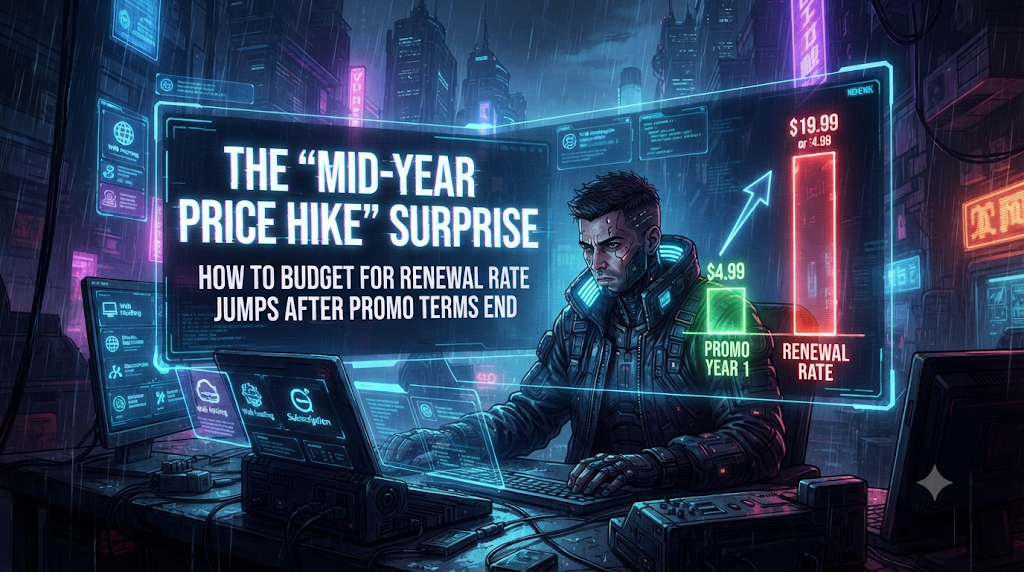
An invoice lands on a random Tuesday. You budgeted for the discounted rate you signed up at, but the charge is several times higher. There was no breach of contract, no traffic spike and no currency swing. The introductory term simply ended, and the account moved to the vendor’s standard renewal price.
Across web hosting, domain registration and WordPress and SaaS tooling, introductory pricing is a standard way to win customers. SiteGround’s StartUp shared plan, for example, is advertised at $2.99 a month and renews at $17.99. GoDaddy has advertised .com promotions as low as $0.01, with renewals reported at $22.99 plus the $0.20 ICANN fee.
For agencies and solo developers, the cost of not separating promo rates from standard renewal rates is a recurring margin leak. Domains get registered during pitches, staging servers get spun up mid-sprint, and plugins get bought to fix one bottleneck. Their renewal cliffs therefore land on scattered dates throughout the year.
This guide uses pricing as of late November 2026. Prices change often, so confirm anything you plan to budget against the vendor’s current pricing page.
The Mechanics of the Promotional Pricing Trap
A low first-term price is an acquisition tool. Vendors are betting you’ll stay, and renew, after the discount ends. That makes the renewal price the number that matters for budgeting.
1. Domains: Registry Costs and Registrar Markups
Domain pricing has two tiers. The registry operates the extension. Verisign runs .com and .net, and Radix administers .tech, .store and .online. The registrar is the retail storefront, such as GoDaddy, Namecheap, Cloudflare or Porkbun, and it sets its own retail price.
The .com floor just moved. Verisign raised its .com wholesale price from $10.26 to $10.97 on November 1, 2026, the maximum 7% increase its agreement allows. Adding the ICANN fee of $0.20 per domain-year, the lowest possible at-cost retail price is now about $11.17. The contract permits further increases in the remaining years of the current six-year period, which runs to 2030.
.net is next. Verisign has announced that the .net wholesale price rises from $10.91 to $12.00, effective March 1, 2027. Registry rules let registrants renew up to 10 years ahead at the current price, which gives you a way to lock in today’s rate if your registrar offers multi-year renewals.
Beyond the registry floor, three things cause renewal jumps:
- Subsidized first terms. A registrar can sell a first-year
.comfar below cost and recover the money on renewal. Retail renewals are often around twice the wholesale cost, and Namecheap and GoDaddy have been reported at roughly $19 and $23 respectively. At-cost and flat-price registrars charge about $11 to $12. - Specialty extensions. Promotional
.techpricing is steep. One registrar lists.techat $6.64 for the first year and $48.37 to renew, and another at $9.20 and $61.40. - .ai’s two-year rule. The Government of Anguilla operates the registry, with Identity Digital as its outsourced technical operator. It enforces a mandatory two-year minimum for registration and renewal. Anguilla’s Executive Council raised the two-year wholesale fee from $140 to $160 from March 1, 2026. Retail renewals at low-cost registrars run about $83 to $86 a year, billed in two-year blocks, and transfers add two years.
Bundled extras also roll off. Free first-year domains and email often become paid items at renewal. One review notes that Hostinger includes email for the first year, then bills about $1.59 per inbox per month.
2. Web Hosting: The Widest Gap
Entry shared hosting shows the biggest spread between promo and renewal prices. The table below uses entry plans with published promo and renewal prices.
| Plan | Promo rate | Renewal rate | Jump | Condition |
|---|---|---|---|---|
| Namecheap Stellar | $1.98/mo | $4.66/mo | +135% | 12-month term |
| Bluehost Starter | $3.99/mo | $9.99/mo | +150% | 36-month term |
| DreamHost Launch | $2.89/mo | $9.99/mo | +246% | 12-month term |
| Hostinger Premium | $2.99/mo | $10.99/mo | +268% | 48-month term |
| SiteGround StartUp | $2.99/mo | $17.99/mo | +502% | 12-month term |
*Sources: Findstack’s renewal comparison and Bluehost’s own pricing guide (September 2026). Some reviews list different Hostinger renewal figures depending on plan and date, so confirm at checkout.*
Managed WordPress hosting behaves differently. Kinsta’s annual rate is its standing price, with about $30 a month per site billed annually. WP Engine’s headline price comes from a first-year coupon: according to a September–October 2026 comparison by InstaWP, a competitor, WP Engine’s $28 a month Essential annual plan is a 20% first-year discount, and the annual price at renewal matches the $35 monthly rate. That is a smaller jump of about 25%, but still a surprise if you budgeted against the coupon price.
Watch how terms are stated. A “$2.99 a month” price usually means paying for a long term up front. At renewal you pay the list price, and you can work out the annual hit with simple arithmetic. A Bluehost Starter plan costs $47.88 a year at $3.99 a month and $119.88 a year at $9.99 a month. SiteGround’s StartUp moves from $35.88 to $215.88 a year at the figures above.
Control-panel licensing adds pressure. cPanel raised its list prices on January 1, 2026, for example Pro from $46.99 to $53.99 a month. A further increase takes effect December 16, 2026, with Solo at $32.99, Admin at $38.99, Pro at $58.99 and Premier at $76.99 a month. Namecheap also raised shared hosting renewal prices from May 19, 2026. Wholesale cost changes can reach your renewal even when your promo rate was locked.
3. WordPress Plugins and SaaS Tools
Plugin and SaaS vendors price renewals differently, so check each one:
- Some renew flat, others don’t. Elementor’s four Editor Pro plans renew at the year-one price. Its Elementor One bundle, as listed by a third-party review on September 29, 2026, starts at $180 and renews at $228. One Agency starts at $432 and renews at $540.
- Plan structures change. WP Rocket’s former “unlimited” Infinite plan became a 50-site Multi plan at the same $299 a year. The price held, but agencies with more than 50 sites needed another solution.
- SaaS pricing is rising broadly. Zylo’s 2026 SaaS Management Index found that 79% of IT leaders encountered price increases at renewal in the previous 12 months. Vertice’s tracker shows SaaS inflation peaking at 16.4% in June 2026 and reading 14.3% in early September.
- Site caps create tier jumps. Agency tiers are often priced by number of sites. When you pass a cap, you move to the next tier at that tier’s price, and a discount on the lower tier may not carry over. Read the vendor’s terms before the 11th client site.
Why Standard Budgeting Misses Renewal Jumps
Many small businesses budget by taking last year’s spend and adding a flat inflation buffer. With the vendor data above, a 5% to 10% buffer is clearly too thin for promotional infrastructure. Three structural problems explain why.
- Dates don’t line up with the fiscal year. Digital assets are bought as projects arrive. A site launched in June 2026 renews in June 2027, whenever your discretionary budget happens to be spent.
- Reminders go to the wrong place. ICANN’s Expired Registration Recovery Policy requires registrars to send renewal reminders about one month and one week before expiry, plus one shortly after expiry. They go to the registrant’s contact email. If that is a former employee’s address or an unwatched alias, nobody sees them. Other vendors set their own schedules. Some auto-renew about 30 days early, as Cloudflare Registrar does, so the charge can land before anyone reviews it.
- Client pass-through leakage. If a client’s care plan was priced on Year-1 promo costs, a $150 a year hosting increase plus a $99 a year plugin renewal across 30 clients is $7,470 a year in unrecovered cost ($249 × 30).
Framework: Auditing and Forecasting Your True Renewal Run-Rate
The fix is to move from cash-basis tracking, what you paid at checkout, to liability-basis forecasting, what the asset costs at standard renewal.
Step 1: Build a Centralized Infrastructure Ledger
Export 12 months of transactions from every card, PayPal account and bank account. Consolidate every domain, hosting plan, SSL certificate, CDN and license into one ledger. Capture these fields for each item:
- Asset and vendor name (for example, a plugin’s agency license)
- Owner or client attribution (internal overhead or a specific billable client)
- Billing cycle (monthly, annual, biennial, multi-year)
- Exact renewal date (YYYY-MM-DD)
- Promo price paid (the actual invoice amount)
- Standard renewal rate (the undiscounted price on the vendor’s pricing page today)
- Renewal delta (standard renewal rate minus promo price, in dollars and percent)
- Auto-renew status and payment method, with only the last four digits of the card
Never put full card numbers, passwords or API keys in a ledger.
Step 2: Calculate Your True Year-2 Run-Rate
Sum the annualized standard renewal rates across all active assets and divide by 12:
True Monthly Run-Rate = (sum of annualized standard renewal rates) ÷ 12As a hypothetical, say your current monthly spend is $850 and your true run-rate is $1,420. You then carry about $570 a month, or $6,840 a year, of latent liability. Budget against the $1,420 figure and any promotional savings you keep become positive variance.
Step 3: Set a 45-Day Pre-Renewal Gate
Registrar reminders arrive about 30 and 7 days before expiry, and other vendors vary. That is too short to migrate a site or test an alternative. Set calendar alerts 45 days before every renewal above a threshold you choose, for example $50. At that mark, ask three questions:
- Utilization. Does this domain still resolve to an active project, and is this plugin running in production? Waste is common at scale. Vertice’s data puts about 16% of SaaS apps as unused and nearly half as underutilized, though that is enterprise-wide, not agency-specific.
- Price-to-value. Does the renewal price still justify the tool, or has a native feature replaced it?
- Negotiate or migrate. If the jump is large, is there enough runway to ask for a better rate or move the workload?
Tactical Playbooks to Reduce Renewal Jumps
1. Move Domains to At-Cost or Flat-Price Registrars
Cloudflare Registrar sells domains at cost, with no markup on registry and ICANN fees. That puts .com at about $11.17 for registration and renewal after the November 1 wholesale increase. The trade-off is that domains must use Cloudflare’s nameservers, so check that fits your DNS setup first.
Porkbun is not at-cost, but it charges one flat price. Its .com is about $11.81 including ICANN fees, with free WHOIS privacy and SSL.
Moving 20 .com domains from a $22.99 renewal to $11.17 saves about $236 a year. That is $22.99 minus $11.17, times 20, at today’s prices.
Transfer rules to know:
- ICANN’s Transfer Policy imposes a 60-day lock after initial registration or a previous transfer. A change of registrant can also trigger a 60-day lock unless it was opted out of beforehand.
- For most gTLDs, a transfer adds one year to the expiration date. Some extensions differ.
.aitransfers add two years. - Start well before expiry. Once a domain expires, restoring it can cost many times the renewal price. One registrar lists
.airestoration at $460 and.techat $210.40.
If you hold .net domains, consider multi-year renewals before March 1, 2027 to lock in the current wholesale rate.
2. Ask for a Retention Offer
Cancelling or turning off auto-renew sometimes surfaces a retention discount, but there is no guarantee. If you contact billing, do it about 30 days before renewal with a short, direct message:
We’re reviewing our annual infrastructure budget ahead of the renewal on [date]. The increase from [promo price] to [renewal price] is above our budget for this tier, and we’re evaluating alternatives. Is there a loyalty rate or multi-year option that would keep us closer to our current cost?
Check the legal backdrop where you operate. The FTC’s Click-to-Cancel rule was vacated by the Eighth Circuit on procedural grounds in July 2025, and the FTC has restarted the rulemaking process. Many states have their own automatic-renewal laws. California’s, amended in July 2025, requires renewal notices 2 to 21 days before a promotional period converts to a paid term, and advance notice of price changes. Many of these laws are written with consumers in mind, so don’t assume they cover business purchases. This is general information, not legal advice.
3. Consolidate Single-Site Licenses into Multi-Site Tiers
Compare per-site cost across tiers using the vendor’s current pricing page. As an illustration, WP Rocket’s single-site license is listed at $59 a year, and its Multi plan covers 50 sites for $299. At five sites, single licenses (5 × $59 = $295) already cost about as much as the Multi plan. Consolidating also gives you one renewal date to track. Confirm the site cap and the renewal terms before you move.
4. Price Client Retainers on Year-2 Retail Math
- Client-direct billing for domains and major SaaS. Register or transfer these under the client’s own account, with the agency as a delegated user. The client then absorbs renewal increases directly.
- Retail-indexed retainers. When you bundle hosting and plugins into a care plan, calculate cost of goods on Year-2 standard renewal prices plus a buffer you choose, such as 15%. Add a clause allowing pass-through of vendor price increases with notice. In Year 1 the promo discount becomes setup margin. In Year 2 your margin holds.
Quarterly Renewal Audit Checklist
- Audit card statements: Match the last 90 days of recurring charges against your ledger.
- Verify standard rates: For renewals in the next 60 days, check vendor pricing pages for increases since last year. Recheck cPanel-dependent hosting after December 16, 2026.
- Turn off default auto-renew on non-critical assets: Experimental domains, staging servers and single-project plugins should need a deliberate approval to renew.
- Lock in known increases: Consider multi-year renewals for
.netnames before March 1, 2027. - Log promo purchases on the day you buy them: Record the renewal price at checkout. Black Friday (November 27, 2026) and Cyber Monday (November 30) deals are typically first-term discounts only.
- Start domain transfers early: Move high-renewal names to at-cost or flat-price registrars at least three weeks before expiry.
- Set 45-day calendar triggers: Every annual, biennial and multi-year contract needs a review reminder before the billing date.